


Contents
Scroll to:
 D. K. Nurgaliev,
G. M. Sungatullina,
N. G. Nourgalieva,
V. V. Silantiev,
A. V. Zhuravlev,
A. V. Chugaev,
D. N. Miftakhutdinova,
Y. V. Goltsman,
B. I. Gareev
D. K. Nurgaliev,
G. M. Sungatullina,
N. G. Nourgalieva,
V. V. Silantiev,
A. V. Zhuravlev,
A. V. Chugaev,
D. N. Miftakhutdinova,
Y. V. Goltsman,
B. I. Gareev https://doi.org/10.18599/grs.2025.4.11
Scroll to:
This study presents the first 87Sr/86Sr isotope data for the Middle–Upper Devonian strata of the central part of the Volga–Ural petroleum province, which are based on ramiform conodont elements. The stratigraphic position of most samples was verified using platform conodonts they contained. The 87Sr/86Sr values obtained are consistent with the global strontium curve, indicating a contiguous connection between this region and the world ocean throughout the Devonian. These results confirm general stratigraphic completeness of the regional succession despite numerous discontinuities and the complex intercalation of black shales, siliciclastics, and carbonates.
Nurgaliev D.K., Sungatullina G.M., Nourgalieva N.G., Silantiev V.V., Zhuravlev A.V., Chugaev A.V., Miftakhutdinova D.N., Goltsman Y.V., Gareev B.I. Strontium Isotope Stratigraphy of the Middle–Upper Devonian: Data for the Conodonts from the Central Part of the Volga–Ural Petroleum Province. Georesursy = Georesources. 2025;27(4):107-118. https://doi.org/10.18599/grs.2025.4.11
The Volga–Ural petroleum province is located on the southeastern margin of the East European Platform, adjacent to the Cis–Ural Foredeep and the Ural Mountains (Fig. 1). The central part of the Volga–Ural province is a large complex multilayer hydrocarbon system confined to the Devonian siliciclastic and carbonate reservoirs (Muslimov, 2007). Owing to its oil-bearing nature, the Devonian stratigraphy of this area has been studied in detail, which makes this region an ideal object for chemostratigraphic studies.
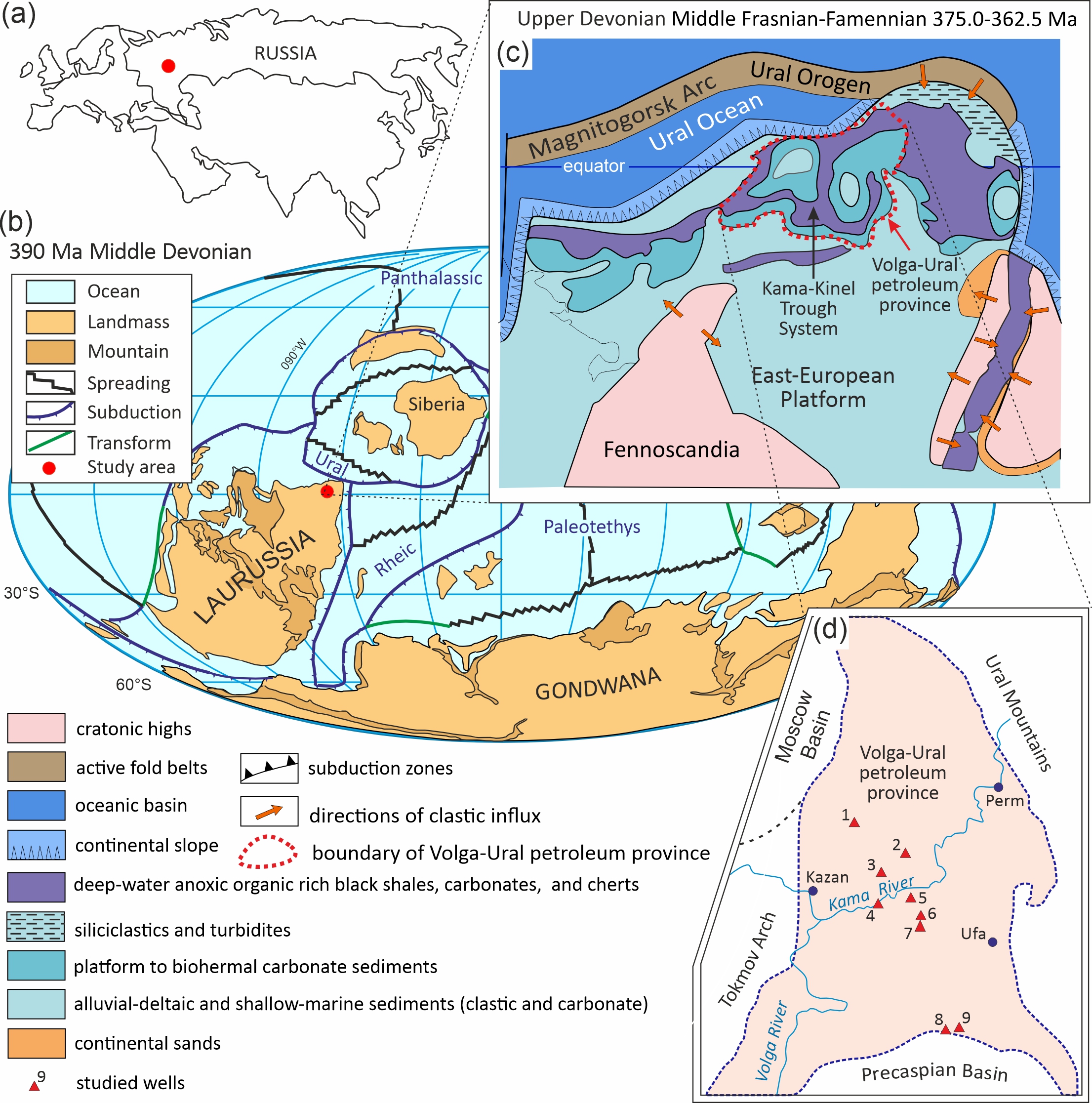
Fig. 1. Location of the studied area and its position in terms of the Middle Devonian palaeogeography: (a) Overview map; (b) Palaeogeographic map (simplified from Golonka (2002), Torsvik, Cocks (2017), Blakey (2021), Scotese (PALEOMAP Project, http://www.scotese.com/)); (c) Middle Frasnian to Famennian palaeogeography of the East European Platform and the Ural Palaeoocean (simplified from Nikishin et al. (1996), Kabanov et al. (2023a)); (d) location of the studied wells within the Volga–Ural petroleum province
Strontium is one of the most abundant elements in the waters of the world ocean, where its concentration shows low variability and weak dependence on depth and salinity, especially in offshore environment (Lebrato et al., 2020; Castro, Huber, 2003). In the recent ocean, the mean Sr concentration in the water is of 7.85±0.03 µg/g (Brass, Turekian, 1972, 1974). The 87Sr/86Sr ratio is determined by two primary sources: the weathering of silicate minerals in terrestrial settings, contributing Sr with a relatively high 87Sr/86Sr ratio, and the hydrothermal activity of mid-ocean ridges, which produce the Sr with a less radiogenic 87Sr/86Sr ratio. The contribution of these sources to the total strontium isotopic composition (87Sr/86Sr ratio) in seawater can be estimated by the following equation:
87Sr/86Srsw = (x)87Sr/86Srrw + (1–x)87Sr/86Srhf ,
where x is the fraction of strontium in seawater derived from river water; and sw, rw, and hf represent the 87Sr/86Sr ratios in seawater (sw), river water (rw), and hydrothermal fluids (hf ) respectively.
The possibility of dating and correlating strata using the 87Sr/86Sr ratio is justified by the regular change in this value during geological time. Strontium isomorphically replaces calcium in carbonate, sulphate, and phosphate minerals (including biominerals), but carbonate is the most commonly analysed material due to its widespread occurrence (McArthur, 1994; Veizer et al., 1999).
The determination of Sr isotopes in Palaeozoic strata is complicated by diagenetic alteration of rocks and fossils. Diagenetic alteration of carbonate rocks and fossils can produce changes in the initial Sr isotopic composition in them, creating difficulties for data interpretation. Thus, it is essential to select suitable objects whose stratigraphic resolution matches the Sr residence time in the ocean (approximately 2.4 million years) (Jones, Jenkyns, 2001) and avoid samples with significant post-sedimentation alteration. Signs of alteration include high levels of silicate, and organic matter, and elevated Mn/Sr and Fe/Sr ratios.
The variation curve of the 87Sr/86Sr ratio for Phanerozoic seawater has been established by integrating data from numerous studies, summarised in reviews (McArthur, 1994; Hairuo et al., 1998; Veizer et al., 1999; McArthur et al., 2020). Van Geldern et al. (2006) provided a key study for the Devonian strontium isotope stratigraphy, constructing the most detailed 87Sr/86Sr curve based on brachiopod shell calcite. Additional reliable data come from studies of brachiopod shell calcite (Brand, 1991, 2004; Zaky et al., 2019) and conodont apatite (Kurschner et al., 1992; Ebneth et al., 1997; Veizer et al., 1997; John et al., 2008; Le Houedec et al., 2017; Emsbo et al., 2018). The 87Sr/86Sr ratio shows two maxima, in the Lower Devonian (0.70870) and in the Upper Devonian (0.70808), separated by a minimum (~0.70782) from the base of the Eifelian to the middle Givetian. This well-defined negative excursion, linked to increased hydrothermal activity at mid-ocean ridges or decreased weathering of 87Sr-rich continental rocks (Jones, Jenkyns, 2001), makes 87Sr/86Sr values suitable for isotope stratigraphy.
Conodonts (class Conodonta, Pander 1856) are extinct small nektonic animals that are similar to the modern chaetognaths. Their tooth-like remains (conodont elements or simply conodonts), composed of biogenic apatite, are commonly used in strontium isotope stratigraphy (e.g., Kurschner et al., 1992; Ebneth et al., 1997; Veizer et al., 1997; Song et al., 2015; Woodard et al., 2013). The strontium isotopic composition in conodont apatite is thought to reflect the composition of seawater at the time of the existence of these organisms.
Conodonts are characterised by the high content of strontium (0.2 to 0.5 wt%) (Pietzner et al., 1968, Wright, 1989; Wright et al., 1990; Bertram et al., 1992; Katvala, Henderson, 2012), which is incorporated into the bioapatite crystal lattice during the growth of the organism and shows a regular pattern in the conodont hard tissues (Zhuravlev, Shevchuk, 2017). Usually, the maximum amount of strontium is concentrated in paralamellar and albid tissues (‘white matter’) (Wright, 1989; Holmden et al., 1996; Zhuravlev, Shevchuk, 2017) of ramiform elements (Holmden et al., 1996), the most common in conodont apparatus. The degree of diagenetic alteration of conodont bioapatite can be assessed by the Colour Alteration Index (CAI), which is used as a proxy of thermal alteration (Kolodny, Epstein, 1976; Epstein et al., 1977). The CAI reflects the alteration and degradation of the organic matter in the conodont tissues. The thermal diagenetic changes in conodont elements also affect the mineral component of the conodont tissues provoking its re-crystallisation and contamination of the conodont bioapatite (Zhuravlev, 2023).
Conodonts offer significant biostratigraphic advantages as objects of chemostratigraphy. Their evolutionary features, ubiquitous distribution in Devonian marine settings, and detailed zonal stratigraphy make them ideal for Sr isotope stratigraphy. The extinction of conodonts in the Late Triassic or earliest Jurassic, which precludes the possibility of direct comparison of their isotope values with modern analogues, is assumed to be the main limitation of conodont application in strontium isotope stratigraphy (Aldridge et al., 1986; Conway-Morris, 1989; Du et al., 2023).
Despite these limitations, the widespread distribution of conodonts in Devonian marine strata, their high strontium content, relative resistance to diagenetic changes, and detailed stratigraphic zonation make conodonts a reliable material for strontium isotope stratigraphy (Kovach, 1980, 1981; Keto, Jacobsen, 1987; Griffin et al., 2021). The aim of this study is the chemostratigraphic interpretation of 87Sr/86Sr values obtained from the Devonian conodonts of the central part of the Volga–Ural province.
The Devonian of the Volga–Ural petroleum province is represented by the Lower, Middle and Upper Series, with a total thickness of 500–1500 m (Fig. 2). The Lower Devonian is locally distributed, whereas the Middle and Upper Devonian are widespread. The stratigraphic completeness of the Devonian geological record of this area is proved by the contiguous succession of conodont zones (Ziegler, 1962, 1969, 1971; Wittekindt, 1966; Bultynck, 1975; Ziegler, Sandberg, 1984, 1990; Aristov, 1988; Rzhonsnitskaya, Kulikova, 1990; Sandberg, Ziegler, 1996; Ovnatanova, Kononova, 2008; Nazarova, Kononova, 2016, 2020; Fortunatova et al., 2018; Becker et al., 2020), which can be traced from the kockelianus Zone of the Eifelian to the Devonian–Carboniferous boundary (Fig. 3).
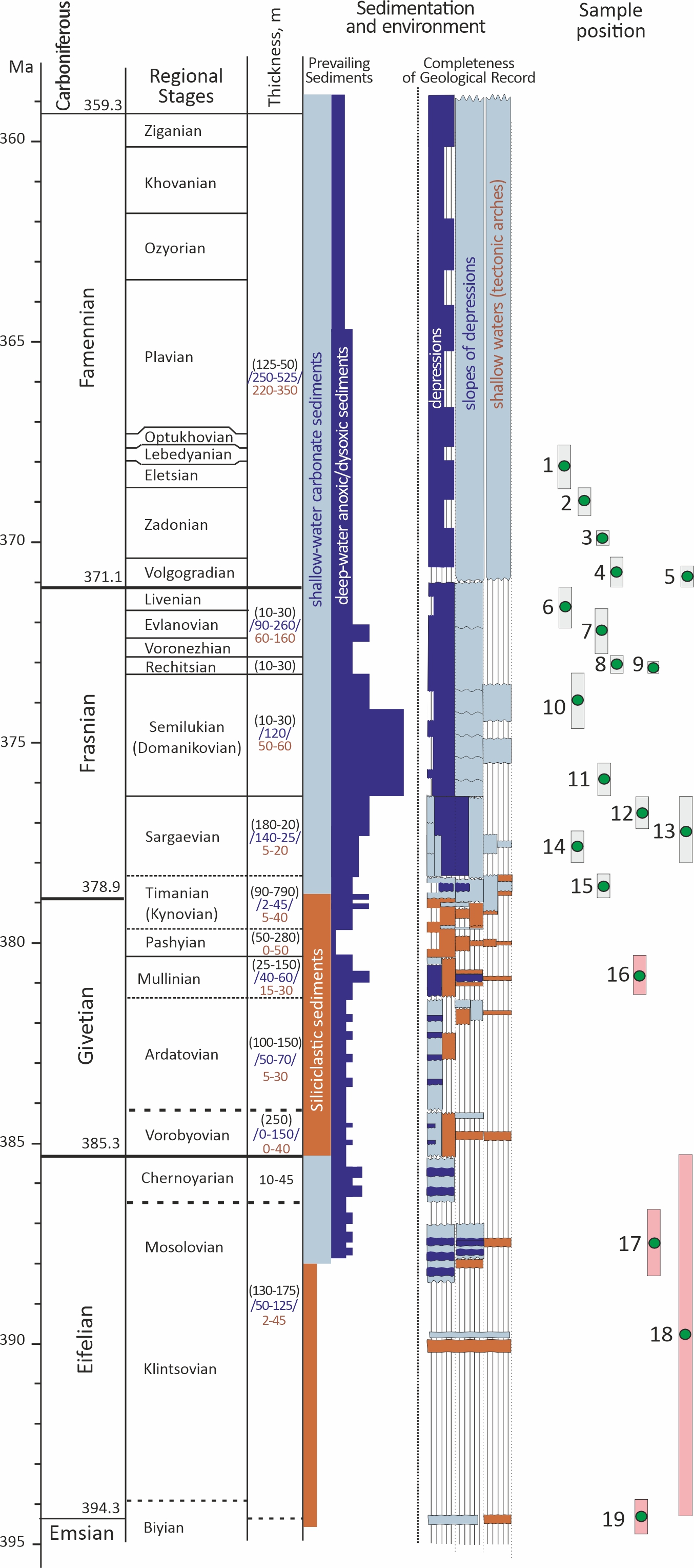
Fig. 2. Main types of sedimentation and completeness of the Devonian succession within Volga–Ural petroleum province. The position of the studied samples is shown. The data on sedimentation are updated from Kabanov et al. (2023a, 2023b). The width of the columns indicates the relative areal distribution of the strata; the white breaks indicate the hiatuses. Thickness indications: black font in parentheses – depressions; blue font in oblique brackets – slopes of depressions; brown font – shallow waters (modified from Silantiev et al. (2024)).
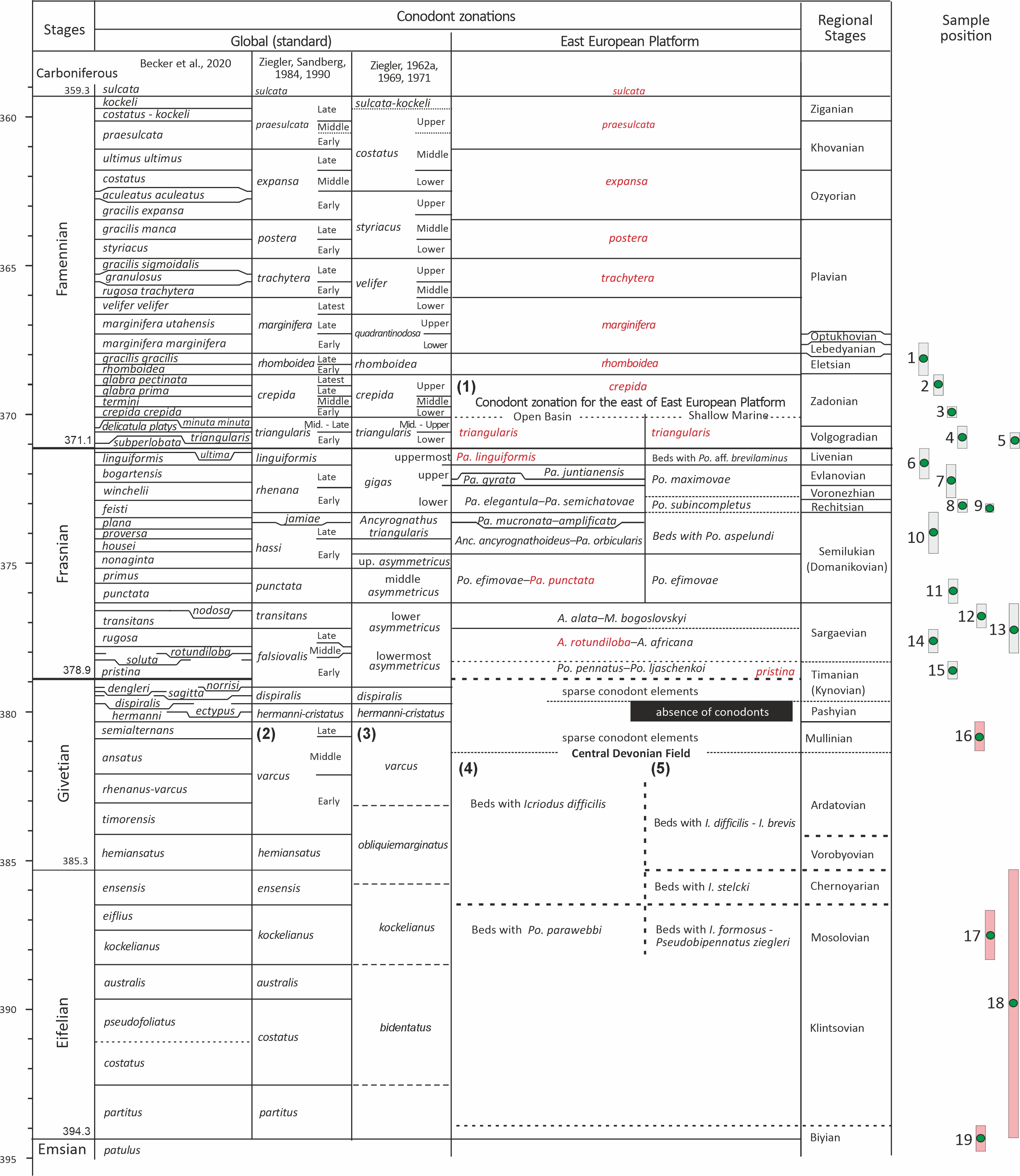
Fig. 3. Position of the studied samples within the framework of the Middle and Late Devonian conodont zonations and regional stratigraphy. Conodont zonations are compiled from: (1) Ovnatanova, Kononova (2008); (2) Sandberg, Ziegler (1996); (3) Bultynck (1975), Aristov (1988); (4) Aristov (1988); (5) Nazarova, Kononova (2016, 2020); red font indicates global or standard conodont zones traceable in the Volga–Ural petroleum province. Regional Stages are given according to Rzhonsnitskaya, Kulikova (1990) and Fortunatova et al. (2018). Samples: the grey rectangles indicate the age determined on conodont data; pink rectangles mean that the position of the sample is determined on geological data; scheme of conodont zonations is modified from Silantiev et al. (2024).
In the central part of the Volga–Ural petroleum province, the Devonian strata form the basal part of the sedimentary cover and unconformably overlie either the Cryogenian-Ediacaran rocks in the aulacogens or the crystalline basement. The composition of the strata, faunal assemblages, thickness and completeness of the succession vary considerably over the area. The Devonian strata include black shales, which are considered to be the oil source, and carbonate and siliciclastic rocks serving as reservoirs (Silantiev et al., 2024).
They consist of organic rich mixed carbonate-clay or siliceous-clay-carbonate rocks. It is assumed that the organic matter of the black shales has originated under euxinic conditions in the photic zone of the Kama–Kinel Trough System (Fig. 1c) (Kabanov et al., 2023a, 2023b). The thickness of the black shales usually is several hundred metres The increase in the thickness observed in some cases was probably caused by the growth in the input of siliciclastic material from the adjacent land.
The faunistic assemblages within the black shales exhibit reduced biodiversity of the benthic fauna, including a few species of brachiopods. In contrast, planktonic and nektonic fossils are more diverse and contain radiolarians, ostracods (Entomozoidae), tentaculitids (mainly dacryoconarids), pteropods (winged molluscs), thin-shelled bivalves, cephalopods, etc.
The accumulation of organic-rich black shales began at the end of the Eifelian and continued until the beginning of the Mississippian (Tournaisian). Usually black shales contain conodonts in quantities suitable for isotope analysis.
Carbonate sediments were accumulated on isolated carbonate buildups (reefs and banks), and on off-reef carbonate and mud ramps. The isolated carbonate buildups (up to 600 m thick) consist of bioclastic, oolitic, microbial limestones containing a rich assemblage of fossils, including foraminifers, stromatoporoids, corals, brachiopods, crinoids and calcareous algae. Sediments of this type were predominantly accumulated along the slopes of the Kama–Kinel trough system (Fig. 1c). Off-reef carbonate and mud ramps consist of bioturbated limestones and mudstones with diverse benthic assemblages. In some cases, the carbonate successions are characterised by stratigraphic incompleteness and gaps.
During the Late Eifelian to Late Givetian, the accumulation of carbonate sediments was restricted to local troughs and was closely related to the accumulation of black shales. Sustainable accumulation of carbonate sediments began at the Early Frasnian and continued until regional regression in the Early Visean (Silantiev et al., 2023, 2024). Limestones containing brachiopods and crinoids usually are rich in conodonts; in limestones of other types, conodonts are rare or absent.
These were accumulated from the late Early Devonian (Emsian) to Early Late Devonian (Frasnian) and, nowadays, are represented by well-sorted sandstones and siltstones interbedded with mudstones. The thicknesses range from hundreds of metres in the troughs to tens of metres in uplifted areas of the tectonic arches. Marine fossils, including conodonts are rare, but various ichnofossil assemblages reveal the marine origin of these sediments (Silantiev et al., 2022, 2024; Miftakhutdinova, 2023).
Conodont elements for 87Sr/86Sr analysis were selected from the extensive collection of the Geological Museum of the Kazan Federal University (coll. nos. 34/24, 34/93, 34/97, 34/99, 34/100), originally assembled by Professor Vyacheslav G. Khalymbadzha (Khalymbadzha, 1981, 2011). In the 1960–1980s, this collection was used to determine the conodont zonation of the Volga–Ural petroleum province (Khalymbadzha, Chernysheva, 1969a, 1969b, 1970a, 1970b). A total of 19 samples from different stratigraphic levels were analysed (Fig. 2, 3).
For 87Sr/86Sr analysis, we used conodonts from carbonate rocks of different facies composition, both from anoxic black shales and from shallow oxic carbonate strata. Such multifacial sampling should not have affected the 87Sr/86Sr values, because the concentration of strontium in seawater is determined by its residence time and is practically independent of basin depth and oxic or anoxic environment, i.e. it is determined only by the rate of strontium input (e.g. from river water or hydrothermal vents) and removal from water (e.g. by precipitation in minerals or participation in biological processes).
The exact stratigraphic position of samples within the conodont zonation and regional stages was determined using platform conodonts where available (Supplementary Material: Figures S1–S5). This approach enabled accurate correlation of most samples with the International Chronostratigraphic Chart (Fig. 3). However, four samples (16–19) lacked platform conodonts and their stratigraphic positions were inferred from geological data, leading to greater uncertainty (Fig. 2).
The 87Sr/86Sr values were measured predominantly from ramiform elements, which are characterised by a higher strontium content (Holmden et al., 1996). In addition, ramiform elements have a smoother surface than platform conodonts, reducing the retention of extraneous mineral particles. Conodont elements were extracted from the host carbonates with acetic acid and were selected manually under a binocular microscope and cleaned of extraneous mineral particles where necessary. The selection process took into account the Conodont Colour Alteration Index (CAI) and the state of preservation of the conodonts. Only specimens with a CAI of 2 or less and showing no signs of redeposition, such as surface erosion or rounding, were selected.
The isotopic composition of Sr in conodonts was studied using thermal ionisation mass spectrometry. The sample weight did not exceed ~0.015 g. The chemical preparation was reduced to dissolution of the sample in 6 M HCl at atmospheric pressure and a temperature of 110 °C for 10–12 hours. The resulting solutions were centrifuged and evaporated. Pure fractions of Sr for mass spectrometric analysis were obtained by ion exchange chromatography. The separation of Sr from matrix elements was carried out in 2.4 M HCl medium on ion-exchange columns filled with 3 mL of Bio Rad W50x8 resin (200–400 mesh). The procedural blanks contained less than 0.1 ng of Sr. The Sr isotopic composition was analysed on a Sector 54 Multicollector Thermionisation Mass Spectrometer (Micromass, UK). Measurements were performed on oxidised tantalum in single-filament mode with a current of centre filament of 2.2–2.7 A, corresponding to a temperature range of 1380–1450 °C. The measurement experiment included the registration of 100 mass-spectra, which provided convergence of results within the analysis no worse than 0.002% (2SE). The accuracy of the mass spectrometric measurements of the 87Sr/86Sr ratio in the samples was controlled by systematic measurements of the international standard of Sr isotopic composition (SRM-987, NIST, USA). Over the period of analysis, the value of 87Sr/86Sr for the SRM-987 standard was 0.710246 ± 0.000016 (n = 10, 2SD).
In addition to the standard control, the accuracy of the 87Sr/86Sr values was checked on a sample from the lower Kungurian (Cisuralian) of the Mechetlino reference section. The 206Pb/238U age of 283.5 ± 0.6 Ma for this sample (Supplementary Material, Table S1, Fig. S3.9) was estimated with high accuracy using a combination of biostratigraphic and radioisotope geochronological methods (Schmitz, Davydov, 2012). The 87Sr/86Sr value of this sample is 0.707394 ± 0.000010 and fits well with the global strontium curve for the Early Kungurian.
The 87Sr/86Sr data were used to compute a Loess model similar to that used by McArthur et al. (2001), with the smoothing algorithm developed by Cleveland (1979) and Cleveland and Devlin (1988). The Loess algorithm employs local regression, a statistical method for fitting smoothing curves without prior assumptions about their shape. The curve was generated using R, an open-source statistical software environment (R Core Team. A language and environment for statistical computing. R Foundation for Statistical Computing, https://www.R-project.org/).
The 87Sr/86Sr values of the Devonian conodonts from the central part of the Volga–Ural petroleum province, along with the Loess trend line, are presented in Figure 4 and in Supplement, Table S1. Sample 19 (Lower Devonian, Biyian regional stage) shows an outlier value, probably due to diagenetic alteration of the conodont material, and is excluded from further discussion. We compare our results with the global Devonian strontium curve derived from brachiopods (Van Geldern et al., 2006) and referenced in the recent Geologic Time Scale volume (McArthur et al., 2020). The overall 87Sr/86Sr values range from 0.707780 ± 0.000012 to 0.708238 ± 0.000018, which are broadly in line with the global trend.
The data clearly reveal two distinct groups of samples, with the first group showing average 87Sr/86Sr values between 0.7077 and 0.7079, and the second group having values in the range of 0.7081 to 0.7082. The lower 87Sr/86Sr values (0.707780–0.707960) are characteristic of the Middle Devonian and Early Frasnian conodonts, whereas the higher values (0.708103–0.708238) are associated with the late Frasnian and Famennian conodonts. The reduced 87Sr/86Sr values in the middle and upper Eifelian can be attributed to increased input of Sr from mantle sources into the world ocean and/or reduced weathering of 87Sr-rich crustal rocks (McArthur et al., 2020).
During the Givetian, a gradual increase in the 87Sr/86Sr ratio is observed. This positive shift, more clearly recorded in the upper Givetian, is generally consistent with the brachiopod-derived strontium curve (Van Geldern et al., 2006).
The positive 87Sr/86Sr excursion in the middle to late Givetian can be interpreted as a consequence of the Acadian–Eovariscan orogeny, expanding the global area of rock weathering and increasing the release of 87Sr from crustal rocks into the world ocean (Van Geldern et al., 2006).
The 87Sr/86Sr values continue to rise in the Early Frasnian, reaching higher levels during the late Frasnian and Early Famennian. The plateaus of elevated values in this stratigraphic interval generally correspond well with the trend observed in the brachiopod-derived strontium curve (Van Geldern et al., 2006). However, the conodont-derived strontium curve shows slightly higher values than the brachiopod-derived curve, a pattern also noted by other researchers (e.g. Ebneth et al., 1997; Zaky et al., 2019).
The global 87Sr/86Sr curve for the Middle–Upper Devonian is mainly based on data obtained from brachiopod shells (Van Geldern et al., 2006; McArthur et al., 2020, and others), although the Sr isotopic composition of Devonian conodonts has also been extensively studied (e.g., John et al., 2008; Woodard et al., 2013; Song et al., 2015; Le Houedec et al., 2017; Emsbo et al., 2018). Conodont elements exhibit relatively high chemical stability and low permeability of hard tissues which lack open pores. During biomineralisation, strontium is gradually incorporated into conodont bioapatite, resulting in a regular distribution of Sr within the hard tissues (Zhuravlev, Schevchuk, 2017). The Sr concentrations in the lamellar and paralamellar tissues of conodont elements show oscillations correlated with the periodic growth of the lamellae (Zhuravlev, Shevchuk, 2017; Shirley et al., 2018). The average Sr concentration in conodont element depends on its growth rate, stage of ontogeny, and, probably, taxonomy (Shirley et al., 2018). Despite the complex Sr distribution pattern in conodont elements the 87Sr/86Sr ratios clearly show very little variation both within a sample and a conodont element. Thus, it is supposed that Sr-isotope signal in conodont elements is independent from conodont taxonomy and the stage of ontogeny, and 87Sr/86Sr ratios in conodont elements directly reflect those in the ancient sea water (Bertram et al., 1992; Terrill et al., 2022). There is no clear evidence of diagenetic exchange of Sr between well-preserved conodont elements and the host rock or pore water (Zhuravlev, Schevchuk, 2019). However, conodonts can absorb manganese (Mn) and rare earth elements (REE) from clayey host rocks (Bertram et al., 1992; Bright et al., 2009; Trotter et al., 2016; Zhuravlev, 2023).
Several recent publications have examined the differences in the Sr isotopic compositions of conodonts and brachiopods (Zaky et al., 2019; Woodard et al., 2013; Song et al., 2015). Specifically, conodonts from the Bird Spring Formation (Carboniferous) have higher levels of the radiogenic isotope 87Sr than brachiopods do (Zaky et al., 2019). The authors suggest that this discrepancy may result from diagenetic alterations in the Sr isotopic composition of conodonts. However, such variations could also be caused by regional or local factors. In particular, this assumption is supported by the Permian–Triassic Sr isotope record of conodonts and brachiopods, where the Sr isotope values are in good agreement (Song et al., 2015).
The 87Sr/86Sr values obtained for the conodonts from the central part of the Volga–Ural petroleum province are largely consistent with those of Devonian brachiopods which are incorporated into the global curve (Fig. 4). However, in some conodont samples, the 87Sr/86Sr values show slight deviations. It is unlikely that only diagenetic processes affecting the conodont elements can explain all these discrepancies.
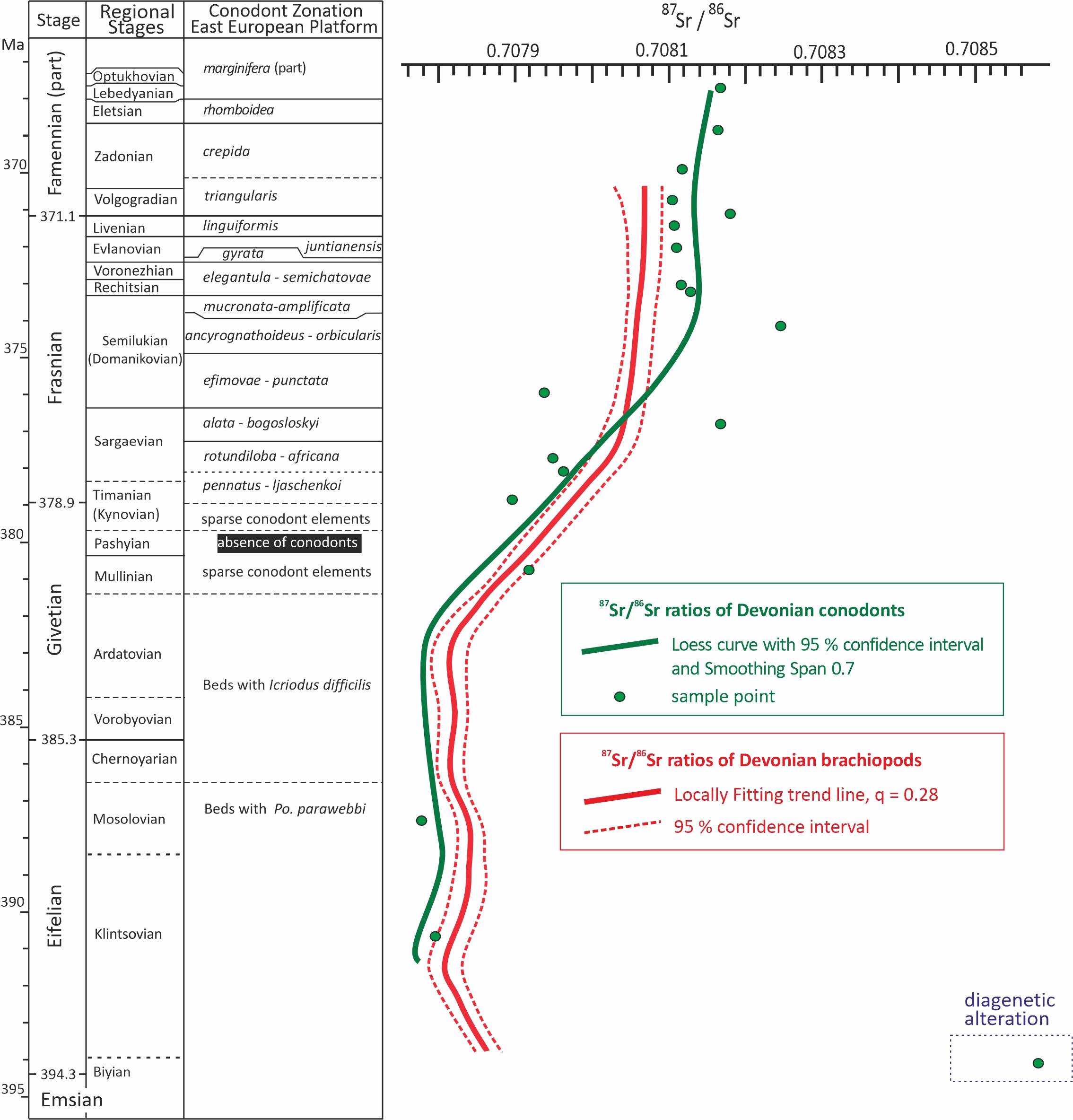
Fig. 4. 87Sr/86Sr values and Loess trend line for Devonian conodonts from the central part of the Volga–Ural petroleum province compared with the strontium curve for brachiopods (Van Geldern et al., 2006)
The lower 87Sr/86Sr values in the Mosolian (Eifelian) and late Timanian–Sargaevian (Early Frasnian) could have been caused by the extensive transgression as well as volcanic and hydrothermal activity in the Ural palaeoocean, which was connected with the Kama–Kinel trough system. In contrast, the higher 87Sr/86Sr values in the Late Frasnian–Famennian could correspond to the enhanced weathering of the western part of the East European Platform.
Our results demonstrate that the general trend of the Devonian 87Sr/86Sr curve for conodonts from the central part of the Volga–Ural petroleum province aligns with the trends of strontium curves for brachiopods, carbonate rocks, and conodonts from other regions (Ebneth et al., 1997; Diener et al., 1996) and with the global 87Sr/86Sr curve (Van Geldern et al., 2006; McArthur et al., 2020) complementing these data with regional variations.
1. The 87Sr/86Sr curve for the conodonts from the central part of the Volga–Ural petroleum province aligns with the global strontium curve, indicating a connection between this region and the global ocean throughout the Devonian.
2. The lower 87Sr/86Sr values in the Eifelian and Early Frasnian could have been caused by the extensive transgression as well as volcanic and hydrothermal activity in the Ural palaeoocean, which was connected with the Kama–Kinel trough system. In contrast, the higher 87Sr/86Sr values in the Late Frasnian–Famennian could correspond to the enhanced weathering of the western part of the East European Platform.
3. Future research could focus on investigating the causes of discrepancies in Sr isotope values between brachiopods and conodonts.
Table S1: 87Sr/86Sr values, stratigraphy of the samples and conodont assemblages using for age determination
Figures S1–S5: Conodont assemblages used for determining the stratigraphic age of the samples
This work has been partly supported (B.I.G) by the Kazan Federal University Strategic Academic Leadership Program (PRIORITY-2030). Biostratigraphic investigation of D.N.M. was funded by a subsidy allocated to the Kazan Federal University for the state assignment project FZSM-2023-0023 in the sphere of scientific activities.
We are very grateful to the editors and anonymous reviewers, whose comments and suggestions significantly improved the article.
1. Aldridge R.J., Briggs D.E.G., Clarkson E.N.K., Smith M.P. (1986). The affinities of conodonts – new evidence from the Carboniferous of Edinburgh, Scotland. Lethaia, 19, pp. 279–291.
2. Aristov V.A. (1988). Devonian conodonts of the Central Devonian field (Russian Platform). Moscow: Nauka, 120 p. (In Russ.)
3. Becker R.T., Marshall, J.E.A., Da Silva, A.-C., Agterberg, F.P., Gradstein, F.M., Ogg, J.G. (2020). The Devonian Period. In: Gradstein, F.M., Ogg J.G., Schmitz M.D., Ogg, G.M., eds., Geologic Time Scale 2020. Volume 2. Amsterdam: Elsevier, pp. 733–810. https://doi.org/10.1016/B978-0-12-824360-2.00022-X
4. Bertram C.J., Elderfield H., Aldridge R.J.; Conway-Morris S. (1992). 87Sr/86Sr, 143Nd/144Nd and REEs in Silurian phosphatic fossils. Earth and Planetary Sciences Letters, 113, pp. 239–249.
5. Blakey R. (2024). DeepTimeMaps™. https://deeptimemaps.com/
6. Brand, U. (1991). Strontium isotope diagenesis of biogenic aragonite and low-Mg calcite. Geochimica et Cosmochimica Acta, 55, pp. 505–513.
7. Brand U. (2004). Carbon, oxygen and strontium isotopes in Paleozoic carbonate components: an evaluation of original seawater-chemistry proxies. Chemical Geology, 204(1-2), pp. 23–44. https://doi.org/10.1016/j.chemgeo.2003.10.013
8. Brass G.W., Turekian K.K. (1972). Strontium distributions in sea water profiles from the Geosecs 1 (Pacific) and Geosecs 11 (Atlantic) test stations. Earth and Planetary Sciences Letters, 16, pp. 117–121.
9. Brass G.W., Turekian K.K. (1974). Strontium distribution in GEOSECS oceanic profiles. Earth and Planetary Sciences Letters, 23(1), pp. 141–148.
10. Bright, C.A., Cruse, A.M., Lyons, T.W., MacLeod, K.G., Glascock, M.D., Ethington, R.L. (2009). Seawater rare-earth element patterns preserved in apatite of Pennsylvanian conodonts? Geochimica et Cosmochimica Acta, 73, pp. 1609–1624.
11. Bultynck P. (1975). Conodontes de la formation de Fromelennes du Givetien de l’Ardenne rancobelge. Bulletin del’Institut royal des Sciences naturelles de Belgique, Sciences de la terre, 50(10), pp. 1–30.
12. Castro P., Huber M.E. (2003). Marine Biology. 4th ed. Boston: McGraw Hill, 480 p.
13. Cleveland W.S. (1979). Robust Locally Weighted Regression and Smoothing Scatterplots. Journal of the American Statistical Association, 74(368), pp. 829–836. https://doi.org/10.1080/01621459.1979.10481038
14. Cleveland W.S., Devlin S.J. (1988). Locally-weighted regression: an approach to regression analysis by local fitting. Journal of the American Statistical Association, 83(403), pp. 596–610. https://doi.org/10.1080/01621459.1988.10478639
15. Conway-Morris S. (1989). Conodont paleobiology: recent progress and unsolved problems. Terra Nova, 1, pp. 135–150.
16. Diener A., Ebneth S., Veize, J., Buhl D. (1996). Strontium isotope stratigraphy of the Middle Devonian: brachiopods and conodonts. Geochimica et Cosmochimica Acta, 60, pp. 639–652.
17. Du Y., Onoue T., Tomimatsu Y., Wu Q., Rigo M. (2023). Lower Jurassic conodonts from the Inuyama area of Japan: implications for conodont extinction. Frontiers in Ecology and Evolution, 11, 1135789. https://doi.org/10.3389/fevo.2023.1135789
18. Ebneth S., Deiner A., Buhl D., Veizer J. (1997). Strontium isotope systematics of conodonts: Middle Devonian, Eifel Mts., Germany. Palaeogeography, Palaeoclimatology, Palaeoecology, 132, pp. 79–96.
19. Emsbo P., Premo W.R., McLaughlin P.I., Neymark L.A., Vandenbroucke T.R.A., Day J.I., du Bray, E.A., Manning A.H., Bancroft A.M. (2018). Impact of Sedimentary-Exhalative Hydrothermal Systems on Marine Chemistry and Mass Extinctions: Applications for Ore Genesis Research and Mineral Exploration. In: Arribas, A.M., Mauk, J.L., eds., Metals, Minerals, and Society. Special Publications of the Society of Economic Geologists, 21, pp. 75–87. https://doi.org/10.5382/SP.21.05
20. Epstein A.G., Epstein J.B., Harris L.D. (1977). Conodont Colour Alteration – An Index to Organic Metamorphism. U.S. Geological Survey Professional Paper, 995, pp. 1–27.
21. Fortunatova N.K., Zaytseva E.L., Bushueva M.A., Shvets-Taneta-Guriy A.G., Baranova A.V., Kononova L.I., Rakhimova E.V., Mikheeva A.I., Oleneva N.V., Avdeeva A.A. (2018). Unified subregional stratigraphic scheme of the Upper Devonian deposits of the Volga-Ural subregion. Explanatory note. Moscow: FGBU VNIGNI, 64. (In Russ.)
22. Golonka J. (2002). Plate-tectonic maps of the Phanerozoic. Society for Sedimentary Geology. Special publication, 72, pp. 21–75.
23. Griffin J.M., Montañez I.P., Glessner J.J.G., Chen J., Willmes M. (2021). Geologic variability of conodont strontium isotopic composition quantified by laser ablation multiple collection inductively coupled plasma mass spectrometry. Palaeogeography, Palaeoclimatology, Palaeoecology, 568, 110308. https://doi.org/10.1016/j.palaeo.2021.110308
24. Hairuo Q., Barnes C.R., Buhl D., Veizer J. (1998). The strontium isotopic composition of Ordovician and Silurian brachiopods and conodonts: Relationships to geological events and implications for coeval seawater. Geochimica et Cosmochimica Acta, 62(10), pp. 1721–1733.
25. Holmden C., Creaser R.A., Muehlenbachs K., Bergstrom S.M., Leslie S.A. (1996). Isotopic and elemental systematics of strontium and neodymium in 454 Ma biogenic apatites: implications for paleoseawater studies. Earth and Planetary Sciences Letters, 142, pp. 425–437.
26. John E.H., Cliff R., Wignall P.B. (2008). A positive trend in seawater 87Sr/86Sr values over the Early–Middle Frasnian boundary (Late Devonian) recorded in well-preserved conodont elements from the Holy Cross Mountains, Poland. Palaeogeography, Palaeoclimatology, Palaeoecology, 269(3–4), pp. 166–175. https://doi.org/10.1016/j.palaeo.2008.04.031
27. Jones C.E., Jenkyns H.C. (2001). Seawater Strontium Isotopes, Oceanic Anoxic Events, and Seafloor Hydrothermal Activity in the Jurassic and Cretaceous. American Journal of Science, 301(2), pp. 112–149. https://doi.org/10.2475/ajs.301.2.112
28. Kabanov P., Hauck, T.E., Gouwy, S.A., Grasby S.E., van der Boon A. (2023a). Oceanic anoxic events, photic-zone euxinia, and controversy of sealevel fluctuations during the Middle-Late Devonian. Earth-Science Reviews, 241, 104415. https://doi.org/10.1016/j.earscirev.2023.104415
29. Kabanov P., Gouwy S.A., van der Boon A., Grasby S.E. (2023b). Nature of Devonian anoxic events based on multiproxy records from Panthalassa, NW Canada. Global and Planetary Change, 227, 104176. https://doi.org/10.1016/j.gloplacha.2023.104176
30. Katvala E.C., Henderson C.M. (2012). Chemical element distributions within conodont elements and their functional implications. Paleobiology, 38, pp. 447–458. https://doi.org/10.1666/11038.1
31. Keto, L., Jacobsen, S. B. (1987). Neodymium and strontium isotopic variations of Early Paleozoic oceans. Earth and Planetary Sciences Letters, 84, pp. 27–41.
32. Khalymbadzha V.G. (1981). Upper Devonian conodonts of the eastern Russian Platform, South Titan, and Polar Urals and their stratigraphic significance. Kazan: Kazan University, 201 p. (In Russ.)
33. Khalymbadzha V.G. (2001). Stages of conodont development in the Late Devonian. Byulleten Moskovskogo obshchestva ispytateley prirody. Otdel geologicheskiy, 76(5), pp. 33–37. (In Russ.)
34. Khalymbadzha V.G., Chernysheva N.G. (1969а). Conodonts of the Upper Devonian deposits of the Volga-Kama region and their stratigraphic significance. Proceedings of the Geological Institute, 24, pp. 155–158 (In Russ.)
35. Khalymbadzha V.G., Chernysheva N.G. (1969b). Stratigraphic significance of Upper Devonian conodonts of the Volga-Kama region and the possibility of their use for interregional correlation. Doklady Akademii Nauk SSSR, 184(5), pp. 1170–1173. (In Russ.)
36. Khalymbadzha V.G., Chernysheva N.G. (1970a). Conodonts of the Ancyrodella genus from the Devonian deposits of the Volga-Kama region and their stratigraphic significance. In: Biostratigraphy and paleonology of the Paleozoic deposits of the East of the Russian platform and the Western Urals. Kazan: Kazan University, pp. 81–103. (In Russ.)
37. Khalymbadzha V.G., Chernysheva N.G. (1970b). Conodonts of the Belodella genus from the Upper Devonian deposits of the Volga-Kama region. In: Biostratigraphy and paleontology of the Paleozoic deposits of the East of the Russian platform and the Western Urals. Kazan: Kazan University, pp. 104–116. (In Russ.)
38. Kolodny Y., Epstein S. (1976). Stable isotope geochemistry of deep sea cherts. Geochimica et Cosmochimica Acta, 40, pp. 1195–1209.
39. Kovach J. (1980). Variations in the strontium isotopic composition of seawater during Palaeoxoic time determined by analysis of conodonts. GSA Abstracts with Programs, 12, p. 465.
40. Kovach J. (1981). The strontium content of conodonts and possible use of the strontium concentrations and strontium isotopic composition on conodonts for correlation purposes. GSA Abstracts with Programs, 13, p. 285.
41. Kurschner W., Becker R.T., Buhl D., Veizer J. (1992). Strontium isotopes in conodonts: Devonian/Carboniferous transition, the northern Rhenish Slate Mountains, Germany. Annales de la Societe Geologique de Belgique, 115(2), pp. 595–622.
42. Le Houedec S., McCulloch M., Trotter J., Rankenburg K. (2017). Conodont apatite δ88/ 86Sr and δ44/ 40Ca compositions and implications for the evolution of Palaeozoic to early Mesozoic seawater. Chemical Geology, 453, pp. 55–65. https://doi.org/10.1016/j.chemgeo.2017.02.013
43. Lebrato M., Garbe-Schönberg D., Müller M.N., Blanco-Ameijeiras S., Feely R.A., Lorenzoni L., Molinero J.-C., Bremer K., Jones D.O.B., Iglesias-Rodriguez D., Greeley D., Lamare M.D., Paulmier A., Graco M., Cartes J., Barcelos e Ramos J., de Lara A., Sanchez-Leal R., Jimenez P., Paparazzo F.E., Hartman S.E., Westernströer U., Küter M., Benavides R., da Silva, A.F., Bell S., Payne C., Olafsdottir S., Robinson K., Jantunen L.M., Korablev A., Webster R.J., Jones E.M., Gilg O., Bailly du Bois, P., Beldowski, J., Ashjian, C., Yahia, N. D., Twining, B., Chen, X.-G., Tseng L.-C., Hwang J.-S., Dahms H.-U., Oschlies A. (2020). Global variability in seawater Mg:Ca and Sr:Ca ratios in the modern ocean. Proceedings of the National Academy of Sciences, 117(36), pp. 22281–22292. https://doi.org/10.1073/pnas.1918943117
44. McArthur J.M. (1994). Recent trends in strontium isotope stratigraphy. Terra Nova, 6(4), pp. 331–358. https://doi.org/10.1111/j.1365-3121.1994.tb00507.x
45. McArthur J.M., Howarth R.J., Bailey T.R. (2001). Strontium isotope stratigraphy: LOWESS version 3: best fit to the marine Sr-isotope curve for 0–509 Ma and accompanying look-up table for deriving numerical age. Journal of Geology, 109(2), pp. 155–170. https://doi.org/10.1086/319243
46. McArthur J.M., Howarth R.J., Shields G.A., Zhou Y. (2020). Strontium Isotope Stratigraphy. In: Gradstein F.M., Ogg J.G., Schmitz M.D., Ogg G.M., eds., Geologic Time Scale 2020. Volume 1. Elsevier, Amsterdam, pp. 211–238. https://doi.org/10.1016/B978-0-12-824360-2.00007-3
47. Miftakhutdinova, D.N. (2023). Using Ichnofossils to Correlate Oil-Bearing Deposits in the Devonian Clastic Succession (Pashyian and Timanian Horizons) of the South Tatar Arch. Uchenye Zapiski Kazanskogo Universiteta Seriya Estestvennye Nauki, 165(4), pp. 688–700. (In Russ.) https://doi.org/10.26907/2542-064X.2023.4.688-700
48. Muslimov R. Kh., (2007). Improving the principles of oil field development. Oil-and-gas content of the Republic of Tatarstan. Geology and development of oil fields, 1, pp. 174–197. (In Russ.)
49. Nazarova V.M., Kononova L.I. (2016). Leading conodont species of the Middle Devonian of the Voronezh anteclise. In: State of the stratigraphic base of the center and southeast of the East European Platform. Moscow: VNIGNI, pp. 51–55. (In Russ.)
50. Nazarova V.M., Kononova L.I. (2020). Conodont assemblages from Givetian deposits (Middle Devonian) of the Shchigry-16 borehole (Voronezh anteclise). In: PALEOSTRAT–2020. Moscow: PIN RAN, pp. 41–42. (In Russ.)
51. Nikishin A.M., Ziegler P.A., Stephenson R., Cloetingh S., Furne A., Fokin P.A., Ershov A.V., Bolotov S.N., Korotaev M., Alekseev A.S., Gorbachev V., Shipilov E.V., Lankreijer A.C., Bembinova E., Shalimov I.V. (1996). Late Precambrian to Triassic history of the East European Craton: dynamics of sedimentary basin evolution. Tectonophysics, 268, pp. 23–63. https://doi.org/10.1016/S0040-1951(96)00228-4
52. Ovnatanova N.S., Kononova L.I. (2008). Frasnian Conodonts from the Eastern Russian Platform. Paleontological Journal, 42(10), pp. 997–1166. https://doi.org/10.1134/S0031030108100018
53. Pietzner H., Vahl J., Werner H., Ziegler W. (1968). Zur chemischen Zusammensetzung und Micromorphologie der Conodonten. Paleontographica, 128, pp. 115–152.
54. Rzhonsnitskaya M.A., Kulikova V.F. (1990). Resolution of the interdepartmental regional stratigraphic meeting on the Middle and Upper Paleozoic of the Russian Platform with regional stratigraphic schemes. Devonian system. Leningrad: Cartographic Factory VSEGEI, 60 p. (In Russ.)
55. Sandberg C.A., Ziegler W. (1996). Devonian conodont biochronology in geologic time calibration. Senckenbergiana Lethaea, 76, pp. 259–265. https://doi.org/10.1007/BF03042852
56. Schmitz M.D., Davydov, V.I. (2012). Quantitative radiometric and biostratigraphic calibration of the Pennsylvanian – Early Permian (Cisuralian) time scale, and pan-Euramerican chronostratigraphic correlation. Geological Society of America Bulletin, 124(3/4), pp. 549–577. https://doi.org/10.1130/B30385.1
57. Shirley B., Grohganz M., Bestmann M. and Jarochowska E. (2018). Wear, tear and systematic repair: testing models of growth dynamics in conodonts with high-resolution imaging. Proceedings of the Royal Society of London, B 285, 20181614. https://doi.org/10.1098/rspb.2018.1614
58. Silantiev V.V., Validov M.F., Miftakhutdinova D.N., Morozov V.P., Ganiev B.G., Lutfullin A.A., Shumatbaev K.D., Khabipov R.M., Nurgalieva N.G., Tolokonnikova Z.A., Korolev E.A., Sudakov V.A., Smirnova A.V., Golod K.A., Leontiev A.A., Shamsiev R.R., Noykin M.V., Kosarev, V. E., Nikonorova D.A., Akhmetov R.F. (2022). Sedimentation model of the middle Devonian clastic succession of the South Tatar Arch, Pashyian Regional stage, Volga-Ural Oil and Gas Province, Russia. Georesursy=Georesources, 24(4), pp. 12–39. (In Russ.) https://doi.org/10.18599/grs.2022.4.2
59. Silantiev V.V., Validov M.F., Miftakhutdinova D.N., Nourgalieva N.G., Korolev E.A., Ganiev B.G., Lutfullin A.A., Shumatbaev K.D., Khabipov R.M., Sudakov V.A., Akhmadullina Yu.A., Golod K.A., Leontev A.A., Shamsiev R.R., Nikonorova D.A., Krikun S.S., Noykin M.V., Abdullina E.A. (2023). Visean terrigenous sediments of the South Tatar Arch (Volga-Urals oil and gas bearing province) – multifacial filling of the karst surface of the Tournaisian isolated carbonate platform. Georesursy=Georesources, 25(4), pp. 3–28. (In Russ.) https://doi.org/10.18599/grs.2023.4.1
60. Silantiev V.V., Miftakhutdinova D.N., Nurgalieva N.G., (2024). From Siliciclastics to Carbonates and Black shales: Deciphering Sedimentary Continuity and Discontinuity in the Devonian Landscapes of the Volga-Ural Petroleum Province. Georesursy = Georesources, 26(4), pp. 62–82. https://doi.org/10.18599/grs.2024.4.1
61. Song H., Wignall P.B., Tong J., Song H., Chen J., Chu D., Tian L., Luo M., Zong K., Chen Y., Lai X., Zhang K., Wang H. (2015). Integrated Sr isotope variations and global environmental changes through the Late Permian to early Late Triassic. Earth and Planetary Science Letters, 424, pp. 140–147. https://doi.org/10.1016/j.epsl.2015.05.035
62. Terrill D.F., Jarochowska E., Henderson C.M., Shirley B., Bremer O. (2022). Sr/Ca and Ba/Ca ratios support trophic partitioning within a Silurian conodont community from Gotland, Sweden. Paleobiology, 48(4), pp. 601–621. https://doi.org/10.1017/pab.2022.9
63. Torsvik T.H., Cocks, L.R.M. (2017). Earth History and Palaeogeography. Cambridge: Cambridge University Press, 332 p. https://doi.org/10.1017/9781316225523
64. Trotter J.A., Barnes C.R., McCracken A.D. (2016). Rare earth elements in conodont apatite: Seawater or pore-water signatures? Palaeogeography, Palaeoclimatology, Palaeoecology, 462, pp. 92–100. https://doi.org/10.1016/j.palaeo.2016.09.007
65. Van Geldern R., Joachimski M.M., Day J., Jansen U., Alvarez F., Yolkin E.A., Ma X.-P. (2006). Carbon, oxygen and strontium isotope records of Devonian brachiopod shell calcite. Palaeogeography, Palaeoclimatology, Palaeoecology, 240(1–2), pp. 47–67.
66. Veizer J., Buhl D., Diener A., Ebneth S., Podlaha O.G., Bruckschen P., Jasper T., Korte C., Schaaf M., Ala D., Azmy K. (1997). Strontium isotope stratigraphy: potential resolution and event correlation. Palaeogeography, Palaeoclimatology, Palaeoecology, 132, pp. 65–77.
67. Veizer J., Davin A., Azmy K., Buhl D., Bruckschen P., Diener В., Bruhn F., Giles A.F.C., Diener A., Ebneth S., Godderis Y., Jasper T., Korte C., Pawellek F., Podlaha O.G., Strauss H. (1999). 87Sr/86Sr, d13C and d18O evolution of Phanerozoic seawater. Chemical Geology, 161, pp. 59–88.
68. Wittekindt H. (1966). Zur Conodonten-Chronologiedes Mitteldevons. Fortschritteder Geologic von Rheinlandund Westfalen, 9, pp. 621–641.
69. Woodard S.C., Thomas D.J., Grossman E.L., Olszewski T.D., Yancey T.E., Miller B.V., Raymond A. (2013). Radiogenic isotope composition of Carboniferous seawater from North American epicontinental seas. Palaeogeography, Palaeoclimatology, Palaeoecology, 370, pp. 51–63. https://doi.org/10.1016/j.palaeo.2012.11.01
70. Wright J. (1989). Conodont Apatite: Structure and Geochemistry. In: Carter, G., ed., Skeletal Biomineralization: Patterns, Processes and Evolutionary Trends, pp. 149–163. https://doi.org/10.1029/SC005p0149
71. Wright J., Conca J.L., Repetski J.E., Clark J. (1990). Microgeochemistry of some Lower Ordovician Cordylodans from Jilin, China. Courier Forschungsinstitut Senckenberg, 118, pp. 307–331.
72. Zaky A., Brand U., Buhl D., Blamey N., Bitner M., Logan A., Gaspard D., Popov A. (2019). Strontium isotope geochemistry of modern and ancient archives: tracer of secular change in ocean chemistry. Canadian Journal of Earth Sciences, 56(3), pp. 245–264. https://doi.org/10.1139/cjes-2018-0085
73. Zhuravlev A.V. (2023). Cathodoluminescence of conodont elements. Vestnik of Geosciences, 7(343), pp. 36–42, https://doi.org/10.19110/geov.2023.7.4
74. Zhuravlev A.V., Shevchuk S.S. (2017). Strontium distribution in Upper Devonian conodonts elements: a palaeobiological proxy. Rivista Italiana di Paleontologia e Stratigrafia, 123(2), pp. 203–210. https://doi.org/10.13130/2039-4942/8311
75. Ziegler W. (1962). Taxionomie und Phylogenie oberdevonischer Conodonten und ihre stratigraphische Bebeutung. Abhandlungen des Hessischen Lijjrdesamtes für Bodenforschung, 38, pp. 1–166.
76. Ziegler W. (1969). Eine neue Conodontenfauna aus dem höchsten Oberdevon. Fortschritte Geologie von Rheinland und Westfalen, 17, pp. 179–191.
77. Ziegler W. (1971). Conodont Stratigraphy of the European Devonian. Geological Society of America Memoir, 127, pp. 227–284. https://doi.org/10.1130/MEM127-p227
78. Ziegler W., Sandberg C. (1984). Palmatolepis-based revision of upper part of standard Late Devonian conodont zonation. Geological Society of America. Special Paper, l96, pp. 179–194.
79. Ziegler W., Sandberg C. (1990). The Late Devonian Standard Conodont Zonation. Courier Forschungsinstitut Senckenberg, 121, pp. 1–115.
Danis K.Nurgaliev – Dr. Sci. (Geology and Mineralogy), Professor, Vice Rector of Petroleum Technologies, Environmental Management, and Earth Sciences
18, Kremlevskaya St., Kazan, 420008
Guzal M. Sungatullina – Cand. Sci. (Geology and Mineralogy), Associate Professor of Department of Paleontology and Stratigraphy
18, Kremlevskaya St., Kazan, 420008
Nuriya G. Nourgalieva – Dr. Sci. (Geology and Mineralogy), Professor, Department of Oil and Gas Geology, Institute of Geology and Petroleum Technology
18, Kremlevskaya St., Kazan, 420008
Vladimir V. Silantiev – Dr. Sci. (Geology and Mineralogy), Professor, Head of Department of Paleontology and Stratigraphy, Institute of Geology and Petroleum Technology, Kazan Federal University; Professor, Kazan Federal University, Branch in Jizzakh
18, Kremlevskaya St., Kazan, 420008
Andrey V. Zhuravlev – Cand. Sci. (Geology and Mineralogy), Senior Researcher, Laboratory of Stratigraphy
54 Pervomaiskaya St., Syktyvkar, 167982
Andrey V. Chugaev – Dr. Sci. (Geology and Mineralogy), Senior Researcher at the Laboratory of Isotope Geochemistry and Geochronology
35, Staromonetny Lane, Moscow, 119017
Dinara N. Miftakhutdinova – Cand. Sci. (Geology and Mineralogy), Associate Professor of Department of Paleontology and Stratigraphy, Kazan Federal University; Associate Professor, Kazan Federal University, Branch in Jizzakh
18, Kremlevskaya St., Kazan, 420008
Yury V. Goltsman – Cand. Sci. (Geology and Mineralogy), Senior Researcher at the Laboratory of Isotope Geochemistry and Geochronology
35, Staromonetny Lane, Moscow, 119017
Bulat I. Gareev – Director of the GeoLab Research Center, Institute of Geology and Petroleum Technology
18, Kremlevskaya St., Kazan, 420008

|
1. Table S1: 87Sr/86Sr values, stratigraphy of the samples and conodont assemblages using for age determination | |
| Subject | ||
| Type | Данные | |
Download
(119KB)
|
Indexing metadata ▾ | |
|
|
2. Figure S1. Famennian conodonts: 1, 3–4. Palmatolepis lobicornis Schülke, well no. 7, Eletsian–Lebedyanian, rhomboidea Zone – marginifera Zone; 2, 5–6. Palmatolepis glabra glabra Ulrich et Bassler, well no. 7, Eletsian–Lebedyanian, rhomboidea Zone – marginifera Zone; 7. Palmatolepis minuta minuta Branson et Mehl, well no. 7, Eletsian–Lebedyanian, rhomboidea Zone – marginifera Zone; 8. Palmatolepis sp., well no. 2, upper Zadonian, crepida Zone; 9–10. Palmatolepis glabra glabra Ulrich et Bassler, well no. 2, upper Zadonian, crepida Zone; 11. Palmatolepis sp., well no. 7, Zadonian, crepida Zone; 12. Palmatolepis aff. regularis Cooper, well no. 2, Volgogradian, triangularis Zone; 13. Palmatolepis tenuipunctata Sannemann, well no. 2, Volgogradian, triangularis Zone; 14. Palmatolepis cf. superlobata superlobata Branson et Mehl, well no. 2, Volgogradian, triangularis Zone; 15. Palmatolepis superlobata superlobata Branson et Mehl. well no. 2, Volgogradian, triangularis Zone; 16. Palmatolepis minuta Branson et Mehl, well no. 2, Volgogradian, triangularis Zone. | |
| Subject | ||
| Type | Данные | |
View
(1MB)
|
Indexing metadata ▾ | |
|
|
3. Figure S2. Famennian and Frasnian conodonts. 1, 3. Palmatolepis cf. superlobata superlobata Branson et Mehl, well no. 2, lower Volgogradian, triangularis Zone; 2. Palmatolepis triangularis Sannemann, well no. 2, lower Volgogradian, triangularis Zone; 4. Ancyrodella ioides Ziegler Morphotype 1, well no. 1, Voronezhian–Evlanovian, elegantula–semichatovae Zone – juntianensis Zone; 5 – Palmatolepis sp., well no. 1, Voronezhian–Evlanovian, elegantula–semichatovae Zone – juntianensis Zone; 6. Palmatolepis aff. ljaschenkoae Ovnatanova, well no. 2, lower Rechitsian, elegantula–semichatovae Zone; 7. Palmatolepis aff. kireevae Ovnatanova, well no. 2, lower Rechitsian, elegantula–semichatovae Zone; 8. Palmatolepis cf. punctata (Hinde), well no. 4, Upper Semilukian, An. ancyrognathoideus–Pa. orbicularis Zone – Pa. mucronata–amplificata Zone; 9–10. Palmatolepis proversa Ziegler, well no. 4, upper Semilukian, An. Ancyrognathoideus–Pa. orbicularis Zone – Pa. mucronata–amplificata Zone; 11. Ancyrodella nodosa Ulrich et Bassler, well no. 4, upper Semilukian, An. Ancyrognathoideus–Pa. orbicularis Zone – Pa. mucronata–amplificata Zone; 12. Polygnathus lingulatus Ovnatanova, well no. 6, lower Semilukian, Po. Efimovae–Pa. punctate Zone. 13. Polygnathus aff. grandidentatus Aristov, well no. 6, lower Semilukian, Po. efimovae–Pa. punctate Zone; 14–15. Ancyrodella pristina Khalymbadzha et Chernysheva, well no. 5, upper Sargaevian, An. alata–M. bogoslovskyi Zone. | |
| Subject | ||
| Type | Данные | |
View
(1MB)
|
Indexing metadata ▾ | |
|
|
4. Figure S3. Frasnian conodonts. 1, 3. Palmatolepis hassi Muller et Muller, well no. 4, lower Rechitsian, elegantula–semichatovae Zone; 2. Palmatolepis jamieae Ziegler et Sandberg, well no. 4, lower Rechitsian, elegantula–semichatovae Zone; 4. Palmatolepis nasuta Muller, well no. 4, lower Rechitsian, elegantula–semichatovae Zone; 5–6. Palmatolepis plana Ziegler et Sandberg, well no. 4, lower Rechitsian, elegantula–semichatovae Zone; 7. Palmatolepis aff. gyratus Kuzmin et Melnikova, well no. 4, lower Rechitsian, elegantula–semichatovae Zone; 8. Polygnathus sp., well no. 4, lower Rechitsian, elegantula–semichatovae Zone; 9. Neostreptognathodus lectulus Chernykh, Mechetlino section, layer 12, lower Kungurian. | |
| Subject | ||
| Type | Данные | |
View
(1MB)
|
Indexing metadata ▾ | |
|
|
5. Figure S4. Frasnian and Famennian conodonts. 1. Mesotaxis falsiovalis Sandberg, Ziegler, Klapper, well no. 3, upper Sargaevian, An. rotundiloba–africana Zone – An. alata–M. bogoslovskyi Zone; 2–3. Mesotaxis asymmetricus (Bischoff et Ziegler), well no. 3, upper Sargaevian, An. rotundiloba–africana Zone – An. alata–M. bogoslovskyi Zone; 4–5. Ancyrodella rotundiloba alata Glenister et Klapper, well no. 3, upper Sargaevian, An. rotundiloba–africana Zone – An. alata–M. bogoslovskyi Zone; 6. Mesotaxis falsiovalis Sandberg, Ziegler et Klapper, well no. 3, upper Sargaevian, An. rotundiloba–africana Zone – An. alata–M. bogoslovskyi Zone; 7. Icriodus nodosus (Hiddle), well no. 6, middle Sargaevian; An. rotundiloba–africana Zone; 8. Icriodus symmetricus Branson et Mehl, well no. 6, middle Sargaevian; An. rotundiloba–africana Zone; 9. Icriodus expansus Branson et Mehl, well no. 6, middle Sargaevian; An. rotundiloba–africana Zone; 10–11. Mesotaxis falsiovalis Sandberg, Ziegler et Klapper, well no. 6, middle Sargaevian; An. rotundiloba–africana Zone; 12–13. Icriodus alternatus Branson et Mehl, well no. 5, Timanian, Po. pennatus–Po. ljaschenkoi Zone; 14. Polygnathus alatus Huddle, well no. 5, Timanian, Po. pennatus–Po. ljaschenkoi Zone; 15. Polygnathus ljaschenkoi Kuzmin, well no. 5, Timanian, Po. pennatus–Po. ljaschenkoi Zone; 16. Ancyrodella prima Khalymbadzha et Chernysheva, well no. 5, Upper Givetian, Mullinian. | |
| Subject | ||
| Type | Данные | |
View
(1MB)
|
Indexing metadata ▾ | |
|
|
6. Figure S5. Eifelian and Frasnian conodonts: 1. Polygnathus politus Ovnatanova, well no. 8, Evlanovian–Livenian, juntianensis Zone – linguiformis Zone; 2–3. Polygnathus komi Kuzmin et Ovnatanova, well no. 8, Evlanovian–Livenian, juntianensis Zone – linguiformis Zone; 4. Polygnathus cf. lodinensis Pölsler, well no. 8, Evlanovian–Livenian, juntianensis Zone – linguiformis Zone; 5. Polygnathus cf. costulatus Aristov, well no. 8, Evlanovian–Livenian, juntianensis Zone – linguiformis Zone; 6. Polygnathus cf. krestovnikovi Ovnatanova, well no. 8, Evlanovian–Livenian, juntianensis Zone – linguiformis Zone; 7. Polygnathus cf. aequalis Klapper et Lane, well no. 8, Evlanovian–Livenian, juntianensis Zone – linguiformis Zone; 8. Polygnathus politus Ovnatanova, well no. 8, Evlanovian–Livenian, juntianensis Zone – linguiformis Zone; 9. Polygnathus aff. pennatus Hinde, well no. 8, Evlanovian–Livenian; 10. Polygnathus cf. webbi Stauffer, well no. 8, Evlanovian–Livenian, juntianensis Zone – linguiformis Zone; 11. Polygnathus aff. pseudofoliatus Wittekindt, well no. 9, Eifelian; 12. Polygnathus cf. linguiformis alveolus Weddige, well no. 9, Mosolovian. | |
| Subject | ||
| Type | Данные | |
View
(1MB)
|
Indexing metadata ▾ | |
|
|
7. Untitled | |
| Subject | ||
| Type | Other | |
Download
(1MB)
|
Indexing metadata ▾ | |
Nurgaliev D.K., Sungatullina G.M., Nourgalieva N.G., Silantiev V.V., Zhuravlev A.V., Chugaev A.V., Miftakhutdinova D.N., Goltsman Y.V., Gareev B.I. Strontium Isotope Stratigraphy of the Middle–Upper Devonian: Data for the Conodonts from the Central Part of the Volga–Ural Petroleum Province. Georesursy = Georesources. 2025;27(4):107-118. https://doi.org/10.18599/grs.2025.4.11
 Email this article (Login required)
Email the author (Login required)
Email this article (Login required)
Email the author (Login required) Address of the Editorial Office: Ametievskaya magistral st., 18, build. 2, ap. 3, Kazan, Republic of Tatarstan, 420087, Russian Federation
Contacts of the Editorial Office: Phone: +7 927 039-05-30, e-mail: mail@geors.ru
Founder: Daria A. Khristoforova
Publisher: Georesursy LLC







.png)

