


Содержание
Перейти к:
https://doi.org/10.18599/grs.2026.2.5
Перейти к:
Для циркона из силикатного мрамора Хапчанского террейна Анабарского щита и сиенитов сухарнинского комплекса гранитоидов Чукотки установлено проявление положительной Eu-аномалии, крайне редкой для этого минерала. В пробе силикатного мрамора положительная Eu-аномалия установлена для поздней генерации циркона с повышенным содержанием неформульных элементов и летучих компонентов. Возраст циркона по верхнему пересечению – 1954±17 млн лет (гранулитовый метаморфизм), нижнее пересечение – 984±49 млн лет (тектонотермальное событие). Циркон с положительной Eu-аномалией тяготеет к нижнему пересечению дискордии, что указывает на связь с поздним воздействием флюидов. Циркон из сиенитов отличается черными высокоурановыми краевыми зонами с положительной Eu-аномалией и обогащением элементами-примесями. Весь циркон образует кластер с конкордантным возрастом около 105 млн лет. Вероятно, возникновение положительной Eu-аномалии в цирконе из сиенитов произошло в результате эволюции закрытой магматической системы, без привлечения стороннего флюида. Циркон из силикатного мрамора, как представляется, зафиксировал эволюцию состава флюидов: 1) ранний флюид обогащен бором и был преимущественно водным, вероятно, мобилизованным из первично-осадочного протолита силикатных мраморов; 2) последующий, предположительно оторванный во времени от гранулитового метаморфизма, был обогащен галогенами (фтором и хлором), что нашло отражение в составе поздних генераций циркона. В работе показано, что нижнее пересечение дискордии, опирающееся на отдельные генерации циркона с особыми геохимическими характеристиками (содержание и спектры REE, амплитуда и знак Се- и Eu-аномалии, содержание неформульных элементов-примесей, Th/U отношение), может отражать реальное геологическое событие, а не является аналитическим артефактом.
Скублов С.Г., Акимова Е.Ю., Салимгараева Л.И., Куричев В.Г., Васюкевич К.Е. Положительная Eu-аномалия в цирконе и проблема идентификации слабо проявленных эндогенных событий. Георесурсы. 2026;28(2):91-103. https://doi.org/10.18599/grs.2026.2.5
Skublov S.G., Akimova E.Yu., Salimgaraeva L.I., Kurichev V.G., Vasukevich K.E. Positive Eu-Anomaly in Zircon and the Problem of Identifying Poorly Manifested Endogenic Events. Georesursy = Georesources. 2026;28(2):91-103. (In Russ.) https://doi.org/10.18599/grs.2026.2.5
Циркон присутствует практически во всех типах горных пород, кроме того, при наложенных процессах он отличается устойчивостью как к химическому выветриванию, так и к физическому истиранию. Содержащиеся в нем примесные элементы и данные по изотопным системам (U-Pb, Hf, O), могут предоставлять исследователям информацию, важную для понимания геологических процессов (Finch, Hanchar, 2003). Магматический циркон также является заметным резервуаром U, Th, Hf и редкоземельных элементов (REE). Эти элементы позволяют реконструировать фундаментальные петрогенетические процессы или являются ключевыми компонентами соответствующих изотопных систем (Hoskin, Schaltegger, 2003). Более того, несовместимость Pb в структуре циркона, относительно высокое содержание U и Th, наряду с высокой температурой закрытия U-Pb изотопной системы, делают его главным минералом для U-Th-Pb геохронологии (Ireland, Williams, 2003). Следует отметить, что данные о содержании Ce, Eu и Ti в цирконе могут дать ценную информацию об условиях образования (Yakymchuk, Kirkland, 2025), в том числе, с помощью геотермометра Ti-in-Zrn (Watson et al., 2006) или оксибарометра (Loucks et al., 2020).
Значительная часть нормированных графиков распределения REE в породах и минералах носит закономерный характер: фракционирование тяжелых или легких REE, зависящее от ряда геологических факторов и связанное с понижением ионного радиуса REE3+ с ростом атомного номера (т.н. лантаноидное сжатие), которое может быть проявлено в плавном понижении или увеличении их нормированного содержания; или отсутствие фракционирования, выражающееся в плоском профиле распределения REE. Однако пологий профиль распределения может усложняться в результате фракционирования индивидуальных REE, это устанавливается по появлению следующих аномалий: Ce-аномалии, Eu-аномалии и тетрадного эффекта в спектре распределения REE (Anenburg, Williams, 2022).
В природе REE присутствуют в основном в трехвалентной форме, кроме того, Ce – в четырехвалентной и Eu – в двухвалентной форме. Окисление Ce до четырехвалентной формы уменьшает его ионный радиус, а восстановление Eu до двухвалентной формы увеличивает его ионный радиус, что «выбивает» их из закономерного ряда REE и приводит к образованию соответствующих аномалий в минералах и породах. Величина аномалии общепринято выражается в численной форме как нормированное отношение измеренного содержания элемента к его предполагаемому в случае отсутствия аномалии, определяемому экстраполяцией по соседствующим с Eu редкоземельным элементам: Eu/Eu* = EuN /(SmN×GdN)1/2; Ce/Ce* = CeN /(LaN×PrN)1/2.
Положительная Се-аномалия характерна для магматического циркона и объясняется присутствием Се4+ в расплаве при соответствующих значениях фугитивности кислорода. Одновременное присутствие в магматическом цирконе положительной Се-аномалии и отрицательной Eu-аномалии, появление которой формально требует более восстановительных условий, считается «цирконовым парадоксом» (Schulz et al., 2006) и может быть объяснено фракционированием плагиоклаза, который обедняет расплав Eu до или во время кристаллизации циркона. В плагиоклаз изоморфно входит стронций, замещая кальций. Стронций, в свою очередь, способствует вхождению европия. Такой тип изоморфизма называется «камуфлированным». Для метаморфического циркона (например, эклогитового генезиса) характерно редуцирование положительной Се- и отрицательной Eu-аномалии, вплоть до их исчезновения (Rubatto, 2002; Skublov et al., 2012; Salimgaraeva et al., 2024). Существенное изменение амплитуды Се- и Eu-аномалий в цирконе, как и их знака, наряду с типом фракционирования REE, уровнем содержания индикаторных элементов-примесей (Li, Hf, U, Y и других) и величиной Th/U отношения, являются ключевыми при идентификации последовательных эндогенных событий, каждое из которых может быть запечатлено соответствующей популяцией или доменом циркона, отличающимися друг от друга вышеперечисленными характеристиками (Skublov et al., 2023; Левашова и др., 2024).
Положительная Eu-аномалия в цирконе является крайне редким явлением и требует специального внимания как с точки зрения объяснения причин ее возникновения, так и в качестве критерия обоснования правомочности выделения отдельных эндогенных событий, связанных с ее проявлением и подтверждаемых датированием U-Pb методом. Ниже в данном контексте будут рассмотрены два примера проявления положительной Eu-аномалии в цирконе: из силикатного мрамора, отобранного в гранулитах палеопротерозойской хапчанской серии, Анабарский щит (обр. 822013), и из сиенита раннемелового сухарнинского комплекса гранитоидов, расположенного на северо-западе Чукотки (обр. 1265).
Обр. 822013 представляет собой клинопироксен-форстеритовый силикатный мрамор. Карбонаты (кальцит и доломит) составляют примерно 80% от объема породы; форстерит – 15%; клинопироксен – 5%; флогопит, шпинель, роговая обманка, циркон, непрозрачные рудные минералы встречены в виде единичных зерен. Широко распространены реакционные структуры: каймы клинопироксена вокруг форстерита, скопления доломита вокруг шпинели. Оливин местами серпентинизирован. Эти признаки свидетельствует о том, что метакарбонатные породы подверглись метасоматической переработке. Силикатные мраморы имеют первично-осадочную природу, о чем свидетельствуют их редкоэлементный состав и наличие обломков вмещающих терригенных пород. PT-параметры, определенные для силикатных мраморов путем построения изохимических Р-Т диаграмм в программном комплексе Perple_X (температуры 700–900 °C и давление не более 8 кбар), отвечают условиям гранулитовой фации метаморфизма (Akimova et al., 2025).
Обр. 1265 – сиенит, отобранный среди гранитоидов Люпвеемского массива сухарнинского комплекса. Комплекс расположен в пределах Алярмаутского поднятия на северо-западе Чукотки, демонстрирует признаки многофазного внедрения и сложной петрогенетической природы. До настоящего времени сухарнинский комплекс остается мало изученным. Образец представляет собой фрагмент крупнозернистой породы (в шлифе установлено всего 5–6 кристаллов – 3–4 калиевого полевого шпата и 2–3 кварца, с включениями биотита, роговой обманки и плагиоклаза). Отмечен единичный кристалл титанита, достигающий в поперечнике 1.2 мм.
Циркон для исследования был выделен с помощью электромагнитной сепарации и тяжелых жидкостей в минералогической лаборатории ИГГД РАН (обр. 822013) и Института Карпинского (обр. 1265). Локальное U-Pb датирование циркона выполнено на ионном зонде высокого разрешения SHRIMP-II (Центр изотопных исследований Института Карпинского) по стандартной методике. Размер аналитического кратера составлял около 20 мкм. Полученные данные обработаны с помощью программы SQUID. Величины U-Pb изотопных отношений нормированы на значения, установленные для стандартов циркона TEMORA и 91500. Ошибки единичных анализов (U-Pb изотопные отношения и возраст) приведены на уровне 1σ, значения конкордантного возраста и возраста пересечения дискордией конкордии – на уровне 2σ. Непосредственно перед датированием была проведена съемка циркона в катодолюминесцентном (CL) режиме на сканирующем электронном микроскопе CamScan MX2500S.
Содержание REE и редких элементов в цирконе определено на ионном зонде Cameca IMS-4f (ЯФ ФТИАН) в той же «точке» диаметром около 20 мкм, что и определение возраста, по стандартной методике (Fedotova et al., 2008). Методика измерения летучих компонентов (вода, фтор и хлор) приведена в работах (Kudryashov et al., 2020; Skublov et al., 2022). Точность определения составляет 10–15% для элементов с концентрацией >1 ppm и 10–20% для элементов с концентрацией 0.1–1 ppm, предел обнаружения составляет 5–10 ppb. При построении спектров распределения REE состав циркона нормирован к составу хондрита СI (McDonough, Sun, 1995). Температура кристаллизации циркона рассчитана с помощью «Ti-в-цирконе» термометра (Watson et al., 2006).
Доступ к данным по геохимии циркона возможен через файлообменник (табл. 1 и 2: https://disk.yandex.ru/i/wFCVEaMiYgwpag). Изотопно-геохимические данные могут быть предоставлены авторами по запросу.
Обр. 822013. Циркон представлен короткостолбчатыми (к. уд. в основном не превышает 1:2) зернами и их обломками, достигающими в поперечнике 250–300 мкм (рис. 1). Внутреннее строение зерен достаточно сложное. Часть зерен сохраняет следы ростовой осцилляционной зональности в темно-серых тонах в CL (например, зерно с точкой 4.1). В большинстве зерен присутствуют изометричные участки практически черного оттенка, секущие эту зональность (например, участок с точкой 12). Самыми последними образуются более светло-серые области перекристаллизации и тонкие секущие прожилки, для которых показательным примером выступает зерно с точкой 8, из-за чего облик зерен становится пятнистым.
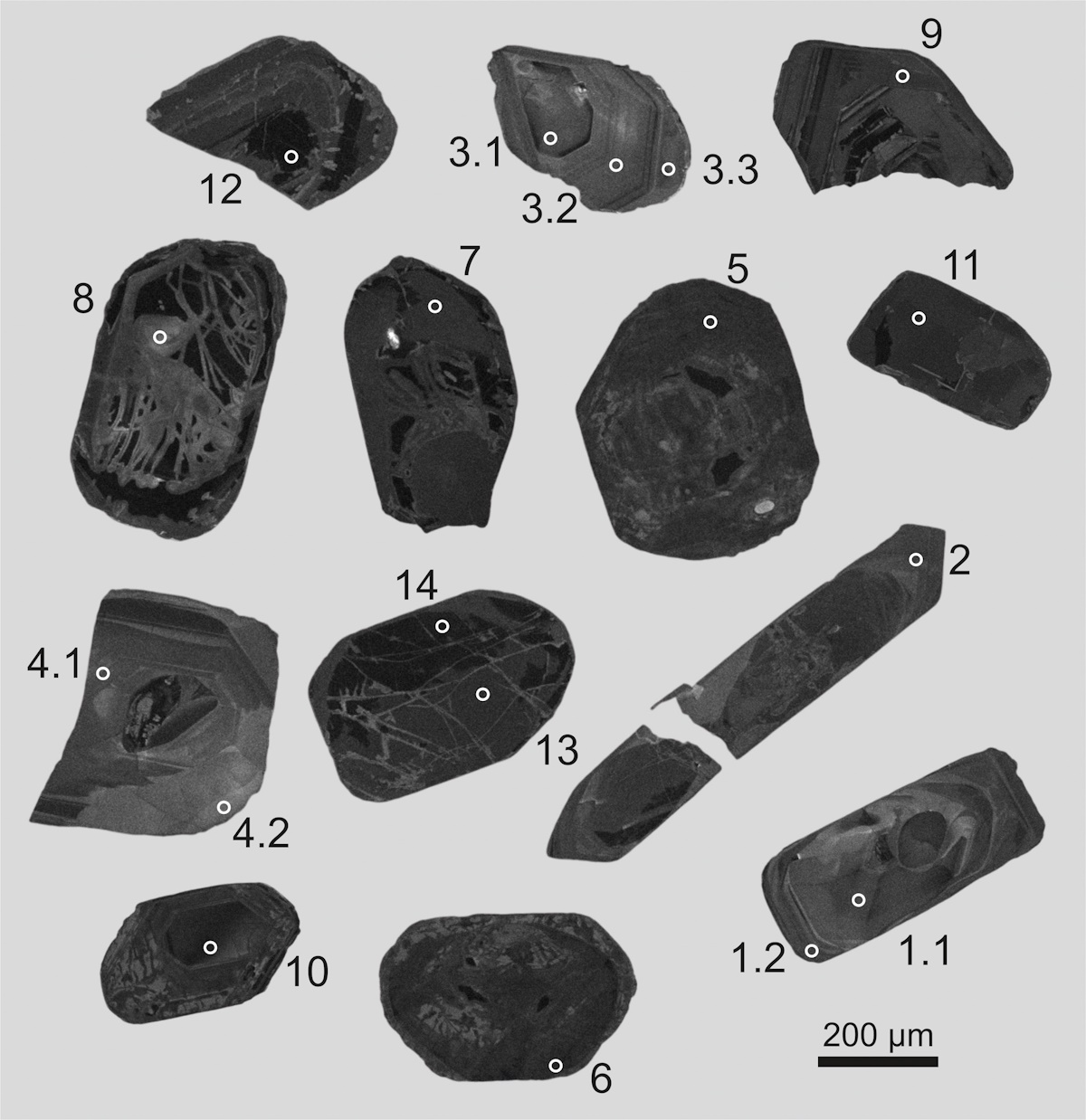
Рис. 1. Изображение циркона из обр. 822013 в режиме CL. Кружками показано положение аналитических точек.
Геохимия циркона. Редкоэлементный состав циркона был проанализирован в 18 точках. По характеру распределения REE и других редких элементов их можно разделить на три группы. К первой группе относятся 10 точек, соответствующих как участкам с наиболее сохранившейся первичной структурой, так и частично перекристаллизованным доменам циркона. Спектры REE в этой группе (рис. 2а) отличаются сильной дифференциацией с ростом от легких к тяжелым REE (LuN/LaN отношение составляет в среднем 1039, за исключением точки 3.3). Точка 3.3, относящаяся к краевой части зерна, выделяется повышенным содержанием легких REE, из-за чего спектр REE приобретает характерные очертания «крыльев птицы», возникающие по причине воздействия флюидов и/ или флюидонасыщенного расплава (Rogova et al., 2024). В этой точке положительная Се-аномалия практически отсутствует (Се/Се* = 1.34), в остальных она хорошо проявлена (Се/Се* в среднем составляет 26.1). Наблюдается выдержанная по величине умеренная отрицательная Eu-аномалия (Eu/Eu* в среднем составляет 0.58). Суммарное содержание REE составляет в среднем 239 ppm.
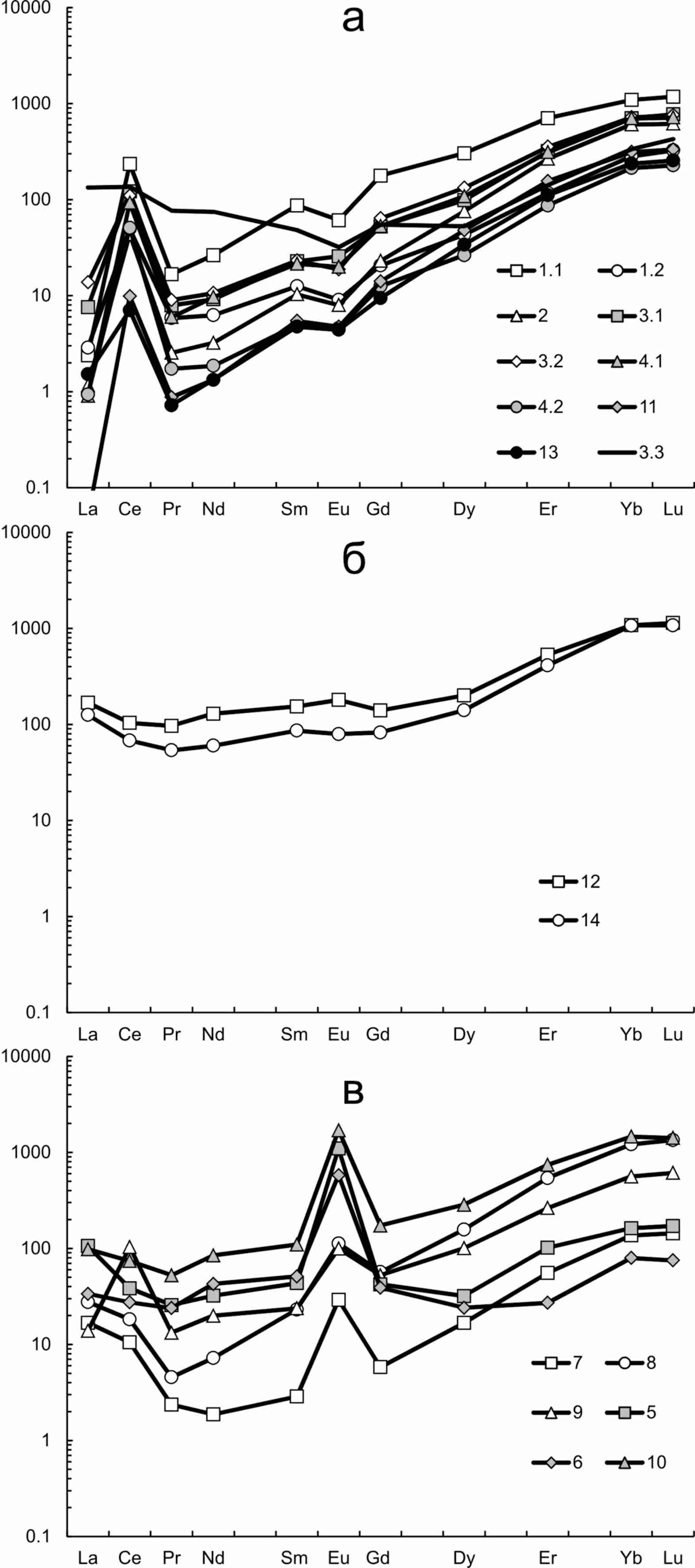
Рис. 2. Спектры распределения REE в цирконе из обр. 822013, нормированные к хондриту CI: а – неизмененный циркон, б – измененный циркон, в – циркон с положительной Eu-аномалией. Здесь и на других рисунках номера отвечают аналитическим точкам.
По содержанию элементов-примесей точка 3.3 также выделяется повышенным содержанием неформульных элементов, рост которых связывается с флюидным воздействием (Са – 278 ppm, Ti – 216 ppm, Sr – 6.22 ppm, Ba – 39.2 ppm). В остальных точках группы содержание неформульных элементов существенно, на порядок, ниже (в среднем, Са – 23.8 ppm, Ti – 17.6 ppm, Sr – 0.85 ppm, Ba – 5.43 ppm). По содержанию Ti возможно рассчитать среднюю температуру образования циркона – около 750 °С, что согласуется с установленными ранее параметрами гранулитовой фации (Akimova et al., 2025). Содержание Th и U составляет в среднем 176 и 462 ppm, соответственно. Th/U отношение варьирует в широком диапазоне – от 0.11 до 0.95, в среднем 0.50, перекрываясь со значениями как для магматического, так и для метаморфического циркона. Содержание Hf достаточно выдержанное и составляет в среднем 9229 ppm, Y – 269 ppm. Все точки характеризуются повышенным содержанием Li (в среднем 25.7 ppm), что свидетельствует о коровой природе циркона (Bouvier et al., 2012). Данная группа отличается умеренным содержанием летучих компонентов (в среднем, ppm): бор – 2.21 (кроме точки 3.3, в которой 8.73 ppm), фтор – 19.5, хлор – 35.8, вода – 969.
Вторая группа состоит из двух точек (12 и 14), относящихся к черным в CL участкам, секущим первичную структуру циркона. Спектры REE для них субгоризонтальные в области легких и средних REE, и умеренно дифференцированы в области тяжелых REE, с ростом от Dy к Yb (рис. 2б). Ce- и Eu-аномалии в этих точках не проявлены. Суммарное содержание REE (в среднем 502 ppm) выше, чем в первой группе.
По содержанию редких элементов точки 12 и 14 выделяются аномально высоким содержанием неформульных элементов: в среднем Са – 10704 ppm, Ti – 2779 ppm, Ba – 4280 ppm, Sr – 592 ppm. Содержание Th и U заметно выше, чем в первой группе, – 518 и 1848 ppm соответственно. Th/U отношение ниже, чем в первой группе, и равняется 0.28. Содержание Hf (10715 ppm) и Y (448 ppm) сопоставимо с первой группой. Примечательно, что содержание Li существенно ниже – 1.95 ppm. Содержание Р на порядок выше, чем в первой группе (601 и 70.8 ppm, соответственно). Точки 12 и 14 также отличаются и повышенным (в 50–100 раз) содержанием летучих компонентов: бор – в среднем 481 ppm, фтор – 1959 ppm, вода – 52240 ppm. Содержание хлора возрастает в 2.5 раза – 84.6 ppm.
Третья группа состоит из 6 точек, отвечающих наиболее перекристаллизованным участкам зерен циркона с характерной пятнистостью и серыми в CL прожилками. Главной особенностью этой группы является наличие положительной Eu-аномалии (рис. 2в). В трех точках (5, 6 и 10), с более высоким содержанием Eu, она проявлена сильнее (Eu/Eu* – в среднем 17.0), в трех других (7, 8 и 9) – амплитуда аномалии ниже (Eu/Eu* – в среднем 4.35). Положительная Се-аномалия присутствует только в точке 9, в других она отсутствует, либо редуцирована. Во всех точках, кроме точки 9, легкие REE дифференцированы от La к Pr с отрицательным наклоном (с понижением нормированного отношения), что указывает на флюидное воздействие (Rogova et al., 2024). Суммарное содержание REE варьирует в широком диапазоне – от 53.2 до 716 ppm (в среднем 292 ppm), что также указывает на изменчивые условия образования этих участков циркона.
Данная группа также отличается повышенным содержанием неформульных элементов, возрастание которых указывает на флюидное воздействие (содержание Са – в среднем 3837 ppm, Ti – 165 ppm, Sr – 244 ppm, Ba – 97.3 ppm). Содержание Р низкое (в среднем 81.4 ppm), что позволяет исключить повышенное содержание легких и средних REE, а также Са и Sr, с микровключениями фосфатов, например, монацита и апатита. Отметим, что максимальное содержание элементов-примесей характерно для точек с наиболее выраженной положительной Eu-аномалией (5, 6 и 10), в трех других оно меньше. По содержанию Ti в точках 7, 8 и 9 возможно рассчитать среднюю температуру образования этой генерации циркона – около 720 °С. Содержание Th и U составляет в среднем 134 и 2775 ppm соответственно. Th/U отношение в целом низкое (от 0.01 до 0.14, в среднем 0.06) и соответствует циркону «гидротермально-метасоматического» типа. Содержание Hf повышенное и составляет в среднем 12569 ppm, Y – 290 ppm. Все точки характеризуются высоким содержанием Li (в среднем 26.3 ppm). Содержание летучих компонентов гораздо выше в точках с максимально проявленной положительной Eu-аномалией (5, 6 и 10), чем в точках с меньшей амплитудой аномалии Eu (7, 8 и 9): бор – в среднем 151 и 15.6 ppm соответственно, фтор – 739 и 108 ppm, хлор – 446 и 81.9 ppm, вода – 15069 и 4924 ppm.
U-Pb возраст. Изотопно-геохимическое исследование было проведено для первой и третьей групп циркона (15 точек). На диаграмме с конкордией (рис. 3) все точки, кроме точек 10, 5 и 6 с максимальной амплитудой положительной Eu-аномалии, образуют конкордантный кластер, для которого рассчитывается конкордантное значение возраста 1945±10 млн лет (СКВО = 0.57). Точки 10, 5 и 6 смещены «вниз» относительно этого кластера. Через все 15 точек возможно провести дискордию со следующими значениями пересечения конкордии: верхнего – 1954±17 млн лет, нижнего – 984±50 млн лет (СКВО = 0.60).
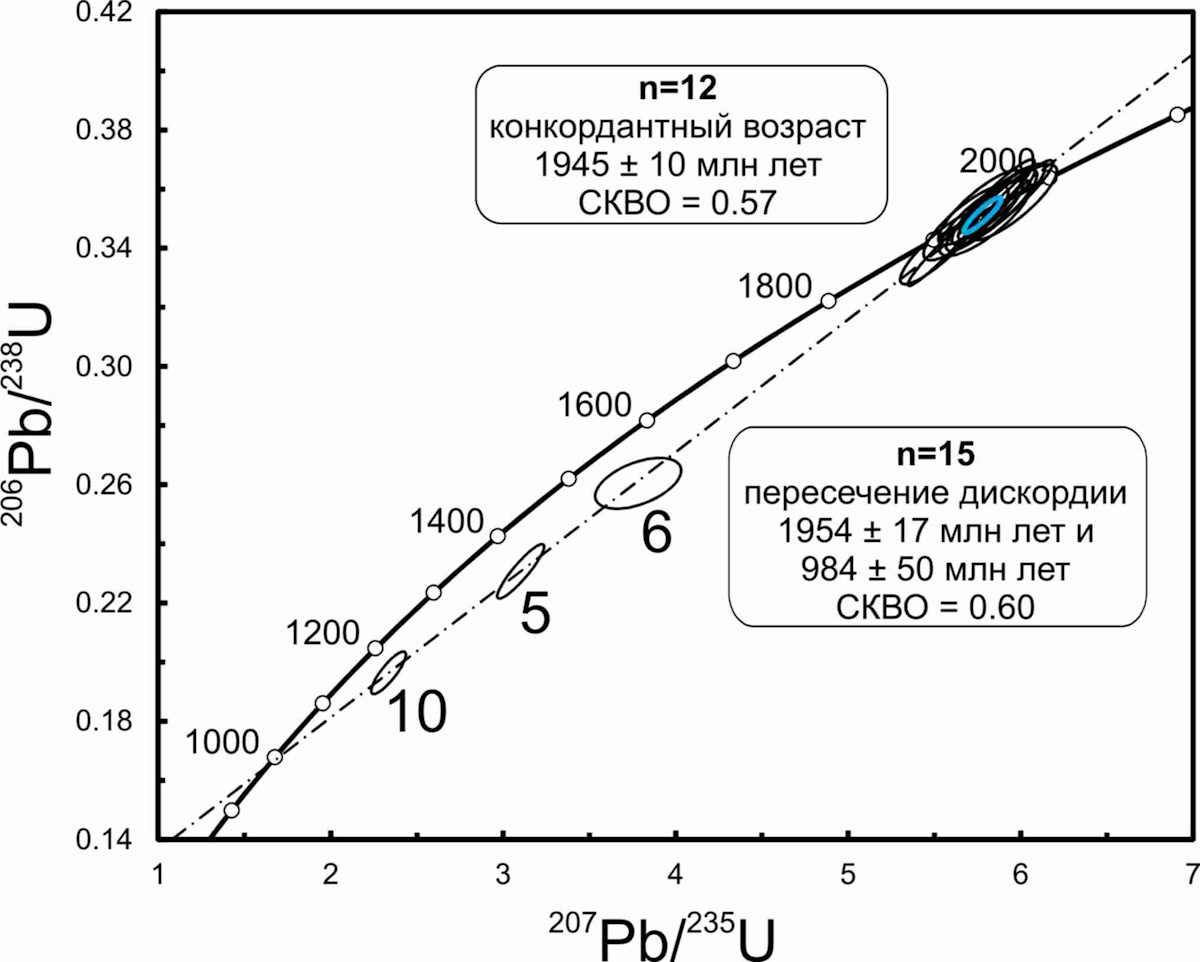
Рис. 3. Диаграмма с конкордией для циркона из обр. 822013. Номерами показаны дискордантные точки.
Обр. 1265. Циркон представлен изометричными зернами, достигающими в поперечнике 150–200 мкм (рис. 4). Центральная часть зерен демонстрирует зонально-секториальное строение с затушеванной тонкополосчатой ростовой осцилляционной зональностью. Центральная часть составляет от 10–15% от всего объема зерна (например, зерно с точкой 10) до 80–90% (зерно с точкой 6). При этом наблюдается закономерность, что зерна с доминирующей центральной частью более идиоморфны, а окраска центральной части в CL более светло-серых оттенков, чем в зернах, где она представлена скорее в виде реликтов. Краевые зоны циркона отличаются черной окраской в CL, их граница в зернах с преобладающей центральной частью, как правило, четко выражена. В зернах с мощной краевой зоной (до 50 мкм, как в зерне с точкой 13) наблюдается плавный переход от центральной части, что позволяет предположить, что последняя испытала перекристаллизацию в процессе образования краевой зоны.
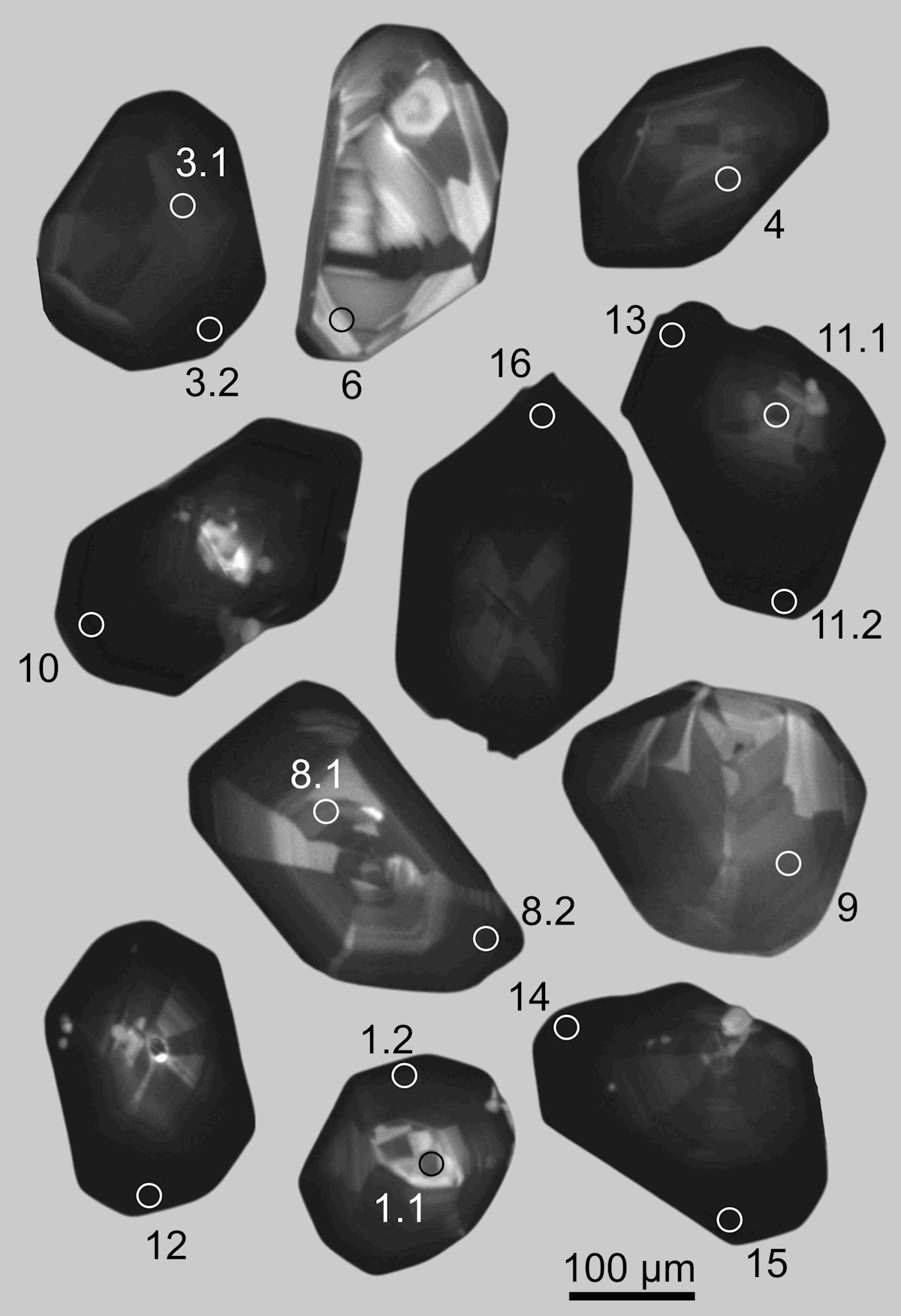
Рис. 4. Изображение циркона из обр. 1265 в режиме CL. Кружками показано положение аналитических точек.
Геохимия циркона. Редкоэлементный состав циркона был проанализирован в 17 точках, которые можно условно разделить на три группы. Центральные части зерен (7 точек, рис. 5а) отличаются дифференцированными спектрами с увеличением от La к Lu (LuN/LaN отношение составляет в среднем 3729), проявлены положительная Се- (Се/ Се* – в среднем 44.2) и отрицательная Eu-аномалии (Eu/ Eu* – 0.24) – эти признаки характерны для циркона магматического генезиса (Hoskin, Schaltegger, 2003). Суммарное содержание REE составляет в среднем 438 ppm.
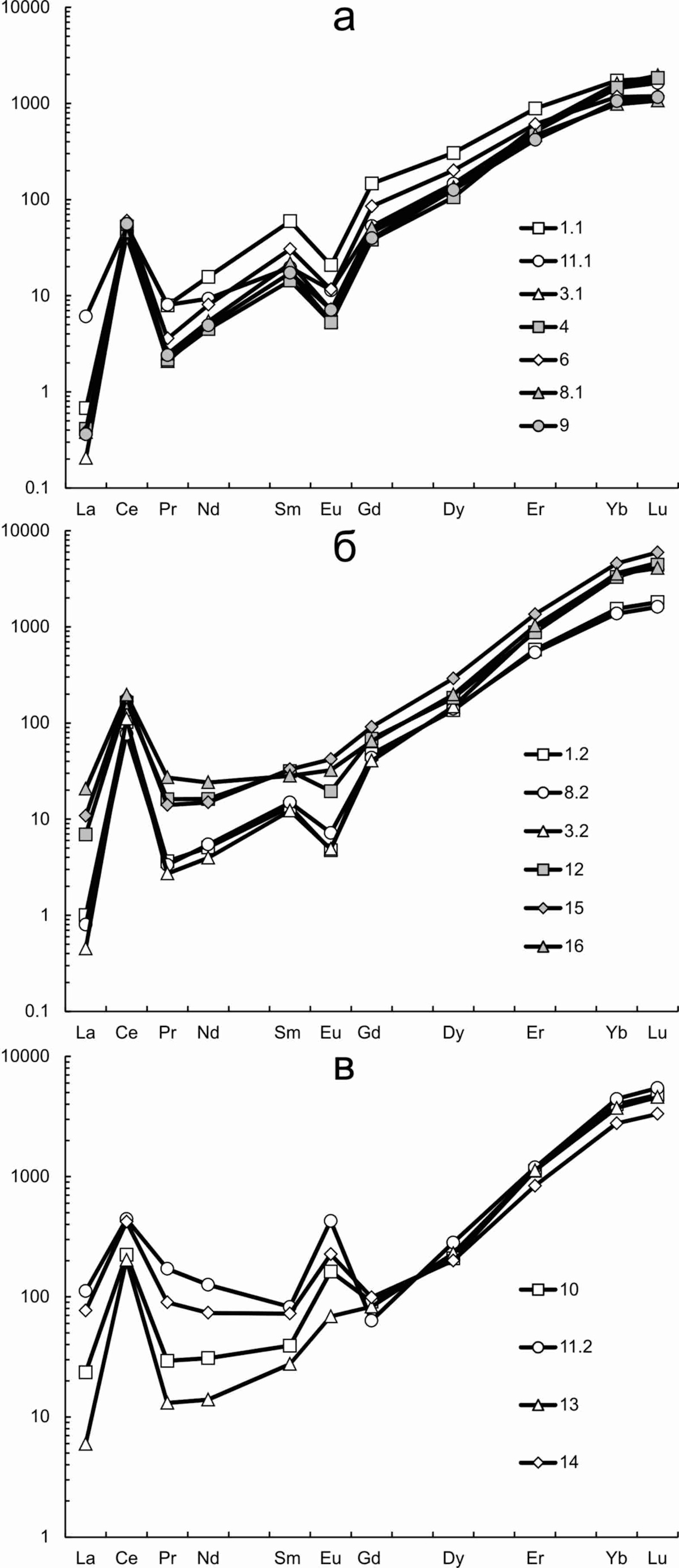
Рис. 5. Спектры распределения REE в цирконе из обр. 1265, нормированные к хондриту CI: а – неизмененный циркон, б – измененный циркон, в – циркон с положительной Eu-аномалией
Содержание неформульных элементов в этой группе умеренное (в среднем, ppm): Ca – 5.67, Ti – 25.3, Ba – 1.96, Sr – 0.34. Температура образования циркона, рассчитанная по Ti-термометру, в среднем равняется 825 °С. Содержание Hf составляет в среднем 9043 ppm, Y – 580 ppm. Содержание Th и U относительно высокое и составляет в среднем 554 и 1196 ppm соответственно. Th/U отношение варьирует от 0.32 до 0.69, в среднем 0.50, что отвечает характеристикам магматического циркона. Содержание Li низкое (в среднем 0.32 ppm), на уровне нижней части диапазона для циркона корового происхождения (Bouvier et al., 2012). Содержание летучих компонентов в центральных частях зерен также незначительное (в среднем, ppm): бор – 1.25, фтор – 0.31, хлор – 14.0 ppm, вода – 362 ppm.
Ко второй группе отнесены 6 точек, расположенные в краевой зоне, но для которых спектры REE не демонстрируют положительной Eu-аномалии (рис. 5б). Дифференцированные спектры REE для трех точек (1.2, 8.2 и 3.2) близки с таковыми для центральных частей зерен: LuN/LaN отношение составляет в среднем 4721, проявлены положительная Се- (Се/Се* – в среднем 66.9) и отрицательная Eu-аномалии (Eu/Eu* – в среднем 0.23). Суммарное содержание REE несколько выше и составляет в среднем 632 ppm. Отличие заключается в повышенном содержании Th (1180 ppm) и U (в среднем 3974 ppm), несколько возрастает содержание Li (1.14 ppm), содержание Ti падает (9.32 ppm), Hf и Y – увеличивается (11627 и 701 ppm, соответственно). Из летучих компонентов примерно вдвое возрастает содержание воды (656 ppm) и в 30 раз – хлора (451 ppm).
В трех других точках этой группы (12, 15 и 16) характер распределения REE заметно отличается от вышеописанных: спектры менее дифференцированы (LuN / LaN отношение составляет в среднем 463) за счет роста содержания легких REE в два раза, содержание тяжелых REE возрастает более чем в два раза, положительная Се-аномалия проявлена меньше (Се/Се* в среднем составляет 12.9), отрицательная Eu-аномалия в значительной степени редуцирована (в среднем Eu/Eu* = 0.65). Содержание Са и Y в этих трех точках выше (в среднем 100 и 1175 ppm соответственно). Наиболее заметен рост содержания Hf, до среднего значения 17169 ppm. Содержание Th практически не увеличивается, но U возрастает до 9418 ppm, что приводит к понижению Th/U отношения до 0.12. Содержание Cl остается на прежнем уровне, заметно возрастает содержание воды (в среднем до 1802 ppm) и фтора (11.0 ppm).
В третью группу (рис. 5в) отнесены точки 10, 11.2, 13 и 14, отличающиеся проявлением положительной Eu-аномалии (Eu/Eu* варьирует от 1.44 до 5.92, в среднем 3.19). Амплитуда положительной Се-аномалии (Се/Се* варьирует от 3.21 до 22.9, в среднем 9.92) отрицательно коррелирует с величиной Се-аномалии. Суммарное содержание REE возрастает до среднего значения 1221 ppm. Характер спектров REE становится менее дифференцированным – LuN/LaN отношение составляет в среднем 266. Содержание Hf остается на среднем уровне – 17238 ppm. Содержание Th и U возрастает до среднего значения 2090 и 11969 ppm соответственно. Th/U отношение составляет в среднем 0.22. Содержание летучих компонентов остается на таком же уровне, как в точках 12, 15 и 16, с редуцированной отрицательной Eu-аномалией. Поэтому есть основания предполагать, что точки, выделенные в третью группу, являются крайней степенью перекристаллизации циркона первой группы, а точки второй группы маркируют промежуточный этап этого процесса.
U-Pb возраст. Изотопно-геохимическое исследование циркона (9 определений) было проведено в точках, относящихся к первой группе, – центральным частям зерен с зонально-секториальным строением. На диаграмме с конкордией (рис. 6) все точки образуют конкордантный кластер, для которого рассчитывается значение конкордантного возраста 105±1 млн лет (СКВО = 0.34).
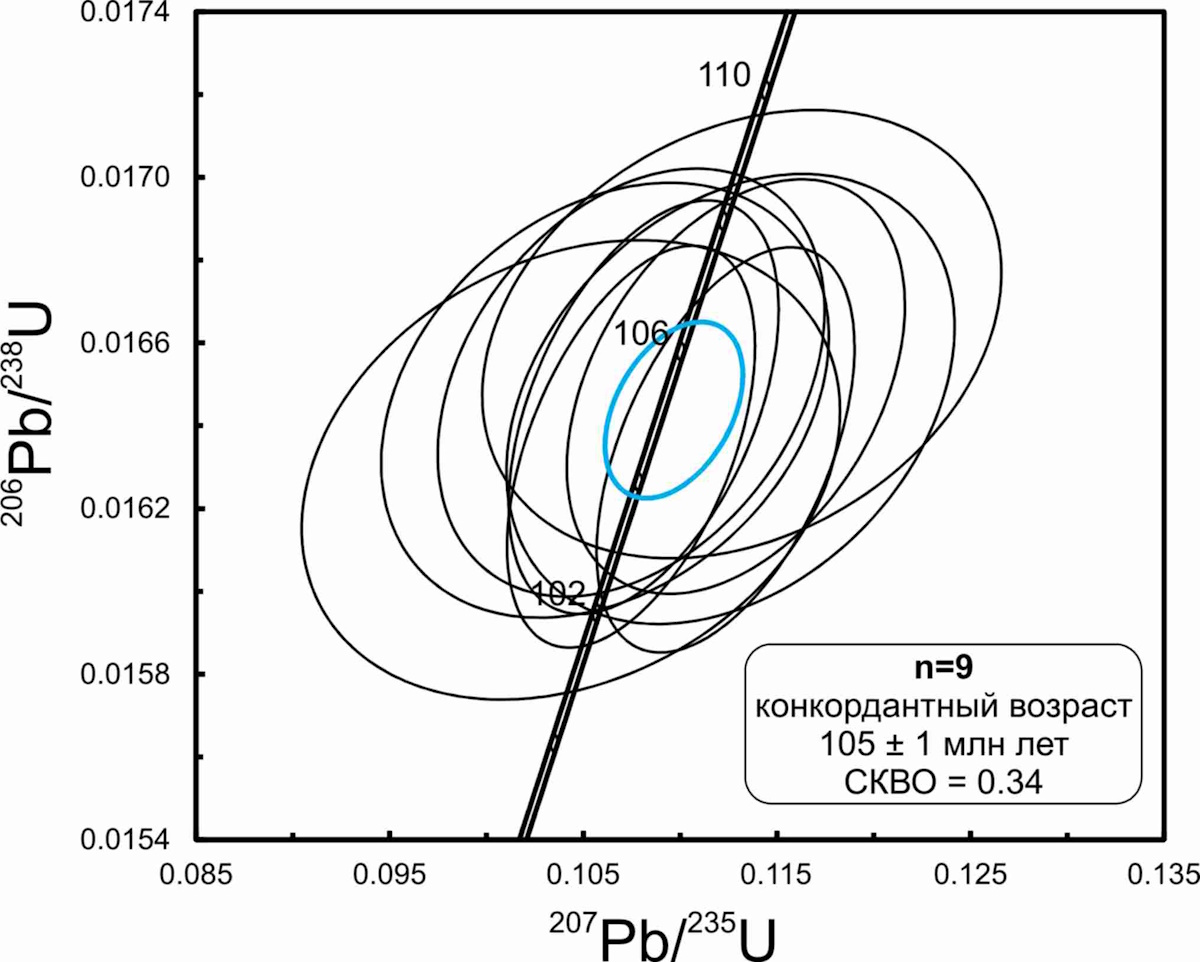
Рис. 6. Диаграмма с конкордией для циркона из обр. 1265
Одним из показательных примеров проявления положительной Eu-аномалии может выступить циркон из архейских кианит-гранат-биотитовых-гнейсов Центрально-Кольской гранулито-гнейсовой области (Skublov et al., 2013). Циркон из них отличается гетерогенным строением: ядра с ростовой осцилляционной зональностью в CL отвечают времени формирования магматического протолита с возрастом около 2.8 млрд лет, серые каймы маркируют регионально проявленный гранулитовый метаморфизм с возрастом около 2.7 млрд лет, что соответствует геологической истории региона. Только в 3% зерен была обнаружена тонкая и черная в CL внешняя каемка. Эти каемки отличаются положительной Eu-аномалией (Eu/ Eu* – до 3.93), высоким содержанием U (до 2000 ppm) и неформульных элементов (Са, Sr), пониженным значением Th/U отношения (до 0.02). При этом содержание Ti и Y в них не аномальное (около 10–15 и 200–400 ppm, соответственно). Спектры распределения REE выположенные, но при достаточно низком уровне содержания редкоземельных элементов (120–260 ppm), что заметно меньше, чем в серых метаморфических каймах.
Вместе с перекристаллизованными ядрами циркона черные каймы образуют дискордию, верхнее пересечение которой с конкордией отвечает возрасту протолита, а нижнее со значением около 570 млн лет было проинтерпретировано как реакция циркона на раннекаледонскую термальную активизацию и связанное с ней воздействие флюидов (Skublov et al., 2013). Косвенно этот вывод подтверждается аномально высоким содержанием в черных каймах кальция – элемента, являющегося для циркона индикатором флюидного воздействия (Geisler, Schleicher, 2000). Все девять дискордантных точек достаточно равномерно распределены вдоль дискордии, при этом точки, отвечающие черным внешним каймам с положительной Eu-аномалией, сгруппированы вблизи нижнего пересечения с конкордией, что и послужило основанием связать эту необычную генерацию циркона с реально проявленным на Фенноскандинавском щите геологическим событием каледонского орогенеза. Примечательно, что на петрографическом уровне и другими изотопными системами (Rb-Sr и Sm-Nd) такое оторванное во времени от основных событий флюидное воздействие на породу не фиксируется. Присутствие аномальных внешних кайм в цирконе с ядрами и внутренними каймами (при этом U-Pb возраст последних вполне ожидаем) позволяет исключить версию о лабораторной контаминации пробы.
Ситуации, когда «молодое» эндогенное событие, наложенное на породу, реконструируется исключительно по нижнему пересечению дискордии при U-Pb датировании циркона не единичны. При этом важно, чтобы нижнее пересечение было зафиксировано отдельной генерацией циркона в пределах зерна (каймы, домены, участки перекристаллизации – т.н. altered zircon), отличающейся от других как особенностями строения (например, интенсивностью и структурой окраски в CL, пористостью, характером и количеством микровключений), так и составом в отношении элементов-примесей.
При датировании циркона из свекофеннских гранитов о-ва Большой Тютерс (Внешние острова Финского залива) также была получена дискордия (Skublov et al., 2024b). Верхнее пересечение дискордии с конкордией (около 1825 млн лет) было принято в качестве возраста кристаллизации гранитов. При этом субконкордантный циркон, находящийся в верхней части дискордии, имеет ростовую осцилляционную зональность и геохимические характеристики циркона магматического генезиса. Возраст нижнего пересечения дискордии (около 570 млн лет) подкреплён самостоятельной генерацией циркона, представленной чёрными в CL-изображении доменами и каймами в цирконе магматической генерации, для которых характерны повышенные содержания неформульных элементов (лёгких REE, Ca, P, Ti, Nb и др.), вплоть до аномальных значений.
Как наиболее вероятную интерпретацию возраста нижнего пересечения дискордии с конкордией можно рассматривать тиманскую (эдиакарскую) или финмаркскую (раннекаледонскую) термальную активизацию Фенноскандинавского щита (Skublov et al., 2024b), ранее установленную по циркону из гнейсов кольской серии, рассмотренному выше. Примечательно, что положительная Eu-аномалия не проявлена в цирконе из гранитов о-ва Большой Тютерс. Напротив, расположенный в нижней части дискордии циркон характеризуется четко выраженной отрицательной Eu-аномалией (Eu/Eu* в пределах 0.04–0.10). Кроме того, наблюдается повышенное содержание легких REE, что придает спектрам распределения REE облик «крыльев птицы», типичный для циркона, испытавшего флюидное воздействие (Rogova et al., 2024). Этот циркон отличается более высоким содержанием U (до 14000 ppm), Ca (до 14500 ppm), P (до 4350 ppm), Ti (до 540 ppm) и Y (до 17000 ppm). Содержание Hf возрастает, по сравнению с магматическими ядрами, от 12000 ppm до 25700 ppm.
По совокупности геохимических признаков (в т.ч. по содержанию неформульных примесных элементов) поздняя генерация циркона из гранитов о-ва Большой Тютерс испытала гораздо более интенсивное флюидное воздействие, чем описанный выше циркон из кольских гранулитов, но положительная Eu-аномалия в нем не проявилась. Поэтому использовать амплитуду Eu-аномалии для оценки интенсивности флюидного воздействия на циркон вряд ли будет корректным. Однако само наличие положительной Eu-аномалии в цирконе, без сомнения, служит индикатором перекристаллизации циркона под воздействием флюидов (вероятно, привносящих европий) и может быть использовано в целях обоснования эндогенных событий, не реконструируемых другими методами, помимо локального U-Pb датирования циркона.
Интерпретация Eu-аномалии в цирконе из обр. 822013. Значение возраста верхнего пересечения дискордии с конкордией около 1950 млн лет, совпадающее в пределах погрешности с конкордантным возрастом этой же генерации циркона из обр. 822013, возможно проинтерпретировать как время гранулитового метаморфизма. Палеопротерозойский гранулитовый метаморфизм в породах Хапчанского террейна Анабарского щита отличается значительной продолжительностью, охватывающей, как минимум, временной интервал 1930–1900 млн лет (Гусев и др., 2024; Skublov et al., 2024a). По всей видимости, возраст метаморфизма силикатных мраморов (около 1950 млн лет) маркирует начало высокотемпературных преобразований пород. Значение возраста верхнего пересечения согласуется с оценками возраста постколлизионного метаморфизма Биляхской тектонической зоны, возникшей в результате коллизии Далдынского и Хапчанского террейнов (Smelov et al., 2012).
Гораздо сложнее проинтерпретировать возраст нижнего пересечения дискордии, составляющий около 980 млн лет. Эндогенные события такого возраста в Хапчанском террейне неизвестны. Однако следует отметить, что базитовый магматизм с возрастом 700–600 млн лет, достаточно заметно проявленный в пределах Сибирского кратона, связывается исследователями с раскрытием палеоазиатского океана и отделением Сибирского кратона от суперконтинента Родиния (Gladkochub et al., 2016). В связи с этими событиями термальное воздействие на Анабарский щит (и Сибирский кратон в целом) было обширным и мощным, что, по-видимому, и зафиксировал исследованный циркон из силикатных мраморов в составе хапчанских гранулитов. Установленное по нижнему пересечению дискордии значение возраста около 980 млн лет, вероятно, отвечает началу распада супеконтинента Родиния (Kheraskova et al., 2010).
Следует отметить, что в цирконе из гранат-ортопироксеновых амфиболитов (обр. 166), отобранных из гранулитов далдынской серии Анабарского щита, ранее (Сергеева и др., 2016) также была установлена положительная Eu-аномалия (Eu/Eu* – в среднем 3.95). Хотя при интерпретации в цитируемой работе эта генерация циркона была сопоставлена с палеопротерозойским метаморфизмом, по трем точкам была построена дискордия с возрастом нижнего пересечения 780±200 млн лет (СКВО = 0.56). По причине большой погрешности для рассчитанного возраста и малого числа точек, образующих дискордию, соответствие полученного возраста геологическим событиям не обсуждалось. В качестве причины возникновения положительной Eu-аномалии было предположено интенсивное воздействие флюидов в неравновесных условиях (Сергеева и др., 2016).
Кроме того, в результате систематического геохронологического исследования циркона из кимберлитовых трубок в северной части Сибирского кратона, «доставленного» кимберлитами из основания Хапчанского террейна, были определены два возрастных интервала главных тектономагматических событий: 2.1–1.8 млрд лет – палеопротерозойские орогенные события, проявленные в коллизии между Анабарской и Оленекской провинциями; 670–144 млн лет – многократная тектономагматическая активизация корово-мантийного взаимодействия, приведшая, в том числе, к формированию Западно-Укикитского кимберлитового поля (Skuzovatov et al., 2021). Среди популяции циркона из трубки Ленинград было встречено зерно с U-Pb возрастом около 892 млн лет, что достаточно близко к обсуждаемому возрасту около 980 млн лет, установленному для циркона из силикатных мраморов Хапчанского террейна по нижнему пересечению дискордии. Такие определения, несмотря на то, что на данный момент являются единичными, существенно расширяют возрастной диапазон повторной активизации основания Сибирского кратона. Высказанные предположения, конечно, требуют в будущем дополнительной верификации представительными геохронологическими данными. Тем не менее, априори считать эти определения возраста аналитическими артефактами не следует.
Интерпретация Eu-аномалии в цирконе из обр. 1265. В противоположность ситуации с цирконом из силикатных мраморов Хапчанского террейна (обр. 822013), циркон из сиенитов сухарнинского комплекса (обр. 1265) не отражает разновозрастные события: проанализированные участки циркона, несмотря на различающиеся особенности редкоэлементного состава, демонстрируют сохранность U-Pb изотопной системы и формируют конкордантный кластер с возрастом около 105 млн лет. Точки, в которых зафиксирована положительная Eu-аномалия, относятся к высокоурановым краевым зонам с характерной черной окраской в режиме CL. Повышенное содержание урана в периферийной части зерен приводит к повреждению кристаллической структуры циркона в процессе радиоактивного распада, что, в свою очередь, инициирует дальнейшее вхождение в структуру неформульных элементов-примесей под воздействием флюидов.
Причина обогащения ураном краевых зон циркона заключается в их образовании на позднемагматической стадии, когда магма обогащается несовместимыми элементами, в том числе и ураном, и становится флюидонасыщенной. Например, для ураноносных гранитов Южного Китая были установлены каймы циркона с содержанием урана, превышающим 25000 ppm (Zhao et al., 2014).
Возможные причины возникновения положительной Eu-аномалии в цирконе. В последнее время для реконструкции условий образования циркона широкое применение получили дискриминационные геохимические диаграммы (Hoskin, 2005; Grimes et al., 2009; Bouvier et al., 2012). Наиболее часто используемая диаграмма соотношения количества La как главного маркера уровня содержания легких REE и показателя степени их фракционирования (La-SmN/LaN) позволяет разделять циркон магматического генезиса и «гидротермальный» циркон, который включает в себя не только циркон, образованный при метасоматизме, но также измененный магматический циркон, подвергшийся интенсивному флюидному воздействию на поздне- или постмагматической стадии (Levashova et al., 2023). Здесь следует подчеркнуть, что гранулитовый циркон по геохимическим характеристикам зачастую не отличим от гранитоидного магматического, по причине того, что его кристаллизация, как правило, также происходит в присутствии расплава. Позднее эта диаграмма была дополнена полем «пористого» циркона, испытавшего воздействие флюидов и имеющего характерное пористое внутреннее строение (Bouvier et al., 2012).
При совместном рассмотрении на диаграмме La-SmN/ LaN (рис. 7) состава циркона из силикатных мраморов Хапчанского террейна (обр. 822013) и сиенитов сухарнинского комплекса (обр. 1265) заметно совпадение их составов. В каждом образце есть типичный магматический (или гранулитовый) циркон и измененный циркон, имеющий геохимические черты гидротермально-метасоматического циркона, в частности, повышенное содержание легких REE и выположенный характер спектра в этой области. Состав циркона из каждого образца ранее был разделен на три геохимических разновидности: 1) соответствующий неизмененному магматическому/гранулитовому циркону по уровню элементов-примесей и характеру спектра REE; 2) отражающий флюидное воздействие и последующую перекристаллизацию (в т.ч. повышенное содержание несовместимых элементов-примесей, а также выположенный характер спектра REE в области легких REE с редуцированной Се-аномалией); 3) с аномальными геохимическими характеристиками, в данном случае с проявлением нетипичной для циркона положительной Eu-аномалии.
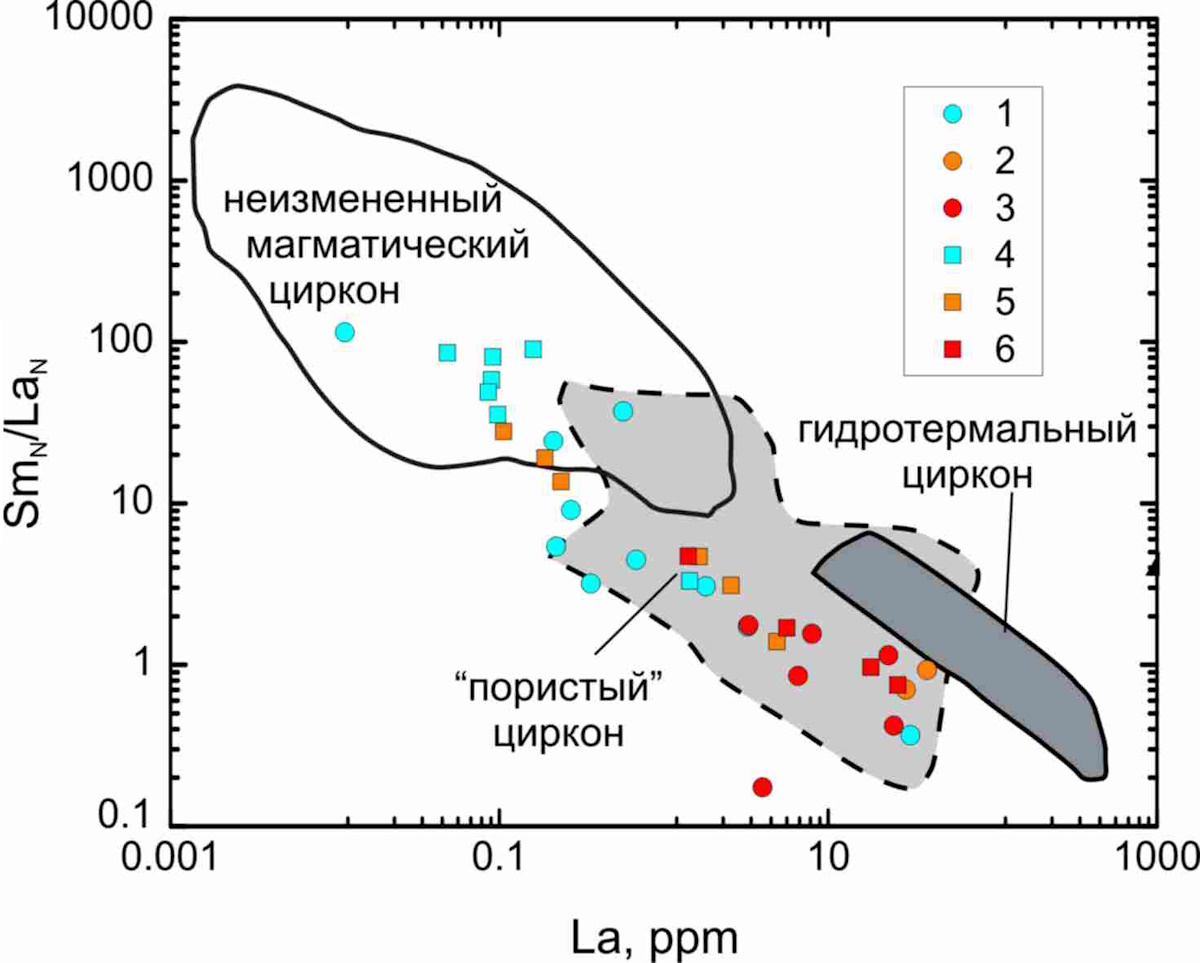
Рис. 7. Дискриминационная диаграмма La-SmN/LaN для определения генезиса циркона. Поля составов приведены по (Hoskin, 2005; Bouvier et al., 2012). Кружками (1–3) показан циркон из обр. 822013; квадратами (4–6) – из обр. 1265; 1 и 4 – неизмененный циркон; 2 и 5 – измененный циркон; 3 и 6 – циркон с положительной Eu-аномалией.
В область магматического циркона попадают только первые две группы циркона из сиенитов сухарнинского комплекса – магматический и частично измененный циркон. Гранулитовый циркон из силикатных мраморов Хапчанского террейна (первая группа) расположен в области пересечения составов магматического и «пористого» циркона, или в области «пористого» циркона. Весь циркон, отличающийся по своим геохимическим характеристикам от магматического – отсутствием существенного фракционирования REE, редуцированием или исчезновением положительной Се-аномалии, возникновением нетипичной для циркона положительной Eu-аномалии, повышенным содержанием неформульных элементов-примесей, включая летучие компоненты, расположен в поле «пористого» циркона, тяготея к области «гидротермального» циркона (рис. 7).
Таким образом, следы флюидного воздействия отражаются в редкоэлементном составе не только циркона с положительной Eu-аномалии, но и в других зернах и их участках, образуя единый тренд изменения состава. Причина возникновения положительной Eu-аномалии в цирконе может быть различной. Большинство существующих на данный момент гипотез связывают ее с унаследованием минералом от флюида, воздействующего на циркон. Прямое исследование флюидов из глубинных океанических гидротермальных систем установило для них плоский спектр распределения REE с четко выраженной положительной Eu- аномалией (Douville et al., 1999).
Численное моделирование поведения REE в процессе декомпрессионной дегазации водо- и хлорсодержащих гранитных расплавов при снижении давления от 3 до 0.5–0.3 кбар в условиях близких к изотермическим (Lukanin, Dernov-Pegarev, 2010) показало, что концентрация и спектр REE в водно-хлоридной флюидной фазе, образующейся при снижении давления, претерпевают существенные изменения в зависимости от содержания летучих компонентов (Cl, H2O) в исходном расплаве, редокс состояния магм, динамики удаления флюидной фазы из магм при их восходящем движении к поверхности. Спектр REE во флюидной фазе по сравнению с расплавом характеризуется более высоким отношением легких REE к тяжелым. При дальнейшем снижении давления и уменьшении концентрации Cl во флюиде знак Eu-аномалии сменяется на положительный аномалией Eu, с увеличением амплитуды аномалии в ходе декомпрессионной дегазации. Такое аномальное поведение Eu в процессе дегазации связано с его нахождением в магматическом расплаве в двух (Eu3+ и Eu2+) валентных формах. Соотношение Eu3+/Eu2+ в расплаве определяется редокс состоянием магматической системы (Lukanin, Dernov-Pegarev, 2010). Распространение вышеизложенного механизма на проявление положительной Eu-аномалии в цирконе из сиенитов сухарнинского комплекса согласуется с установленным аномально высоким содержанием хлора (до 1100 ppm) в перекристаллизованном с разной степенью интенсивности магматическом цирконе краевых зон, но еще имеющим редуцированную отрицательную Eu-аномалию. В цирконе с положительной Eu-аномалией содержание хлора, как минимум, в два раза ниже, что отражает резкое изменение состава флюида.
Если отрицательную Eu-аномалию в спектрах REE для гранитов и слагающих их минералов обычно интерпретируют как свидетельство более раннего выделения (фракционирования) плагиоклаза, то положительную Eu-аномалию в минералах, для которых она не характерна, таким способом не объяснить. Тем не менее, также была высказана точка зрения, что альбитизация ранее образовавшегося плагиоклаза приводит к обеднению гранитов Eu и обогащению пегматитового расплава этим элементом (Fowler, Doig, 1983).
Оба рассмотренных выше механизма (декомпрессионная дегазация и фрракционирование гранитного расплава) объясняют возникновение положительной Eu-аномалии в цирконе из сиенитов сухарнинского комплекса (обр. 1265) в результате эволюции закрытой магматической системы, без привлечения стороннего флюида.
В случае с цирконом из силикатных мраморов Хапчанского террейна (обр. 822013) возможно реконструировать эволюцию состава флюидов. Ранний флюид был обогащен бором (до 520 ppm в цирконе второй геохимической группы) и был преимущественно водным. Вероятно, он был мобилизован из первично-осадочного протолита силикатных мраморов. Более поздний флюид, предположительно, оторванный во времени от гранулитового метаморфизма, был обогащен галогенами (фтором и хлором), что нашло отражение в составе поздних генераций циркона. Механизм его возникновения на данный момент не очевиден, требуются специальные дополнительные исследования.
Проведено изотопно-геохимическое исследование циркона из двух пород (из силикатных мраморов Хапчанского террейна Анабарского щита и сиенитов сухарнинского комплекса гранитоидов Чукотки), для которого было установлено проявление положительной Eu-аномалии, крайне редко наблюдаемой в цирконе.
В цирконе из силикатных мраморов положительная Eu-аномалия установлена для поздней генерации циркона – светло-серых в CL областей перекристаллизации и тонких секущих прожилков. В них легкие REE дифференцированы от La к Pr с отрицательным наклоном (профиль типа «крыльев птицы»), повышено содержание неформульных элементов (Ca, Ti, Sr, Ba), что вкупе указывает на флюидное воздействие. Th/U отношение в целом низкое (в среднем 0.06) и соответствует циркону «гидротермально-метасоматического» типа. Содержание летучих компонентов (вода, бор, фтор и хлор) гораздо выше в участках с максимально проявленной положительной Eu-аномалией, чем в точках с меньшими амплитудой Eu-аномалии. Весь проанализированный циркон образует дискордию со значениями пересечения конкордии: верхнего – 1954±17 млн лет (гранулитовый метаморфизм), нижнего – 984±49 млн лет (молодое тектонотермальное событие). Точки циркона с положительной Eu-аномалией тяготеют к нижнему пересечению дискордии, что указывает на связь ее возникновения с поздним воздействием флюидов.
Циркон из сиенитов отличается черными высокоурановыми краевыми зонами с нечеткой границей с центральными частями с реликтами ростовой полосчатой зональности. Участки с положительной Eu-аномалией, расположенные в краевых зонах, являются крайней степенью перекристаллизации неизмененного циркона центральных частей зерен. Смена знака Eu-аномалии на положительный коррелируется с обогащением циркона элементами-примесями. На диаграмме с конкордией все точки циркона образуют кластер со значением конкордантного возраста около 105 млн лет.
Вероятно, возникновение положительной Eu-аномалии в цирконе из сиенитов сухарнинского комплекса произошло в результате эволюции закрытой магматической системы, без привлечения стороннего флюида. Циркон из силикатных мраморов, расположенных в гранулитах хапчанской серии Анабарского щита, как представляется, зафиксировал эволюцию состава флюидов: 1) ранний был обогащен бором и был преимущественно водным, вероятно, он был мобилизован из первично-осадочного протолита силикатных мраморов; 2) последующий, предположительно оторванный во времени от гранулитового метаморфизма, был обогащен галогенами (фтором и хлором), что нашло отражение в составе поздних генераций циркона. Механизм его возникновения на данный момент не очевиден, требуются специальные дополнительные исследования.
В работе показано, что нижнее пересечение дискордии, опирающееся на отдельные генерации циркона с особыми геохимическими характеристиками (уровень содержания и характер спектров REE, амплитуда и знак Се- и Eu-аномалии, содержание неформульных элементов-примесей, Th/U отношение), весьма вероятно связано с реальным геологическим событием, а не является аналитическим артефактом.
Работа выполнена в рамках темы государственного задания ИГГД РАН (FMUW-2022-0005).
Авторы благодарят Н.И. Гусева (Институт Карпинского) за обсуждение результатов исследования и С.Г. Симакина, Е.В. Потапова (ЯФ ФТИАН) за помощь в аналитических исследованиях циркона. Рекомендации двух рецензентов способствовали улучшению текста рукописи.
1. Гусев Н., Романова Л., Скублов С. (2024). Геохимия и возраст циркона из аккреционной олистостромы хапчанской серии Анабарского щита. Геология и минерально-сырьевые ресурсы Северо-Востока России: материалы XIV Международной научно-практической конференции, посвященной 300-летию Российской Академии наук и 100-летию золотодобывающей промышленности РС(Я), 26-29 марта 2024 г. Якутск: Издательский дом Академии наук РС(Я), с. 307–313.
2. Левашова Е.В., Скублов С.Г., Хамдард Н., Иванов М.А, Стативко В.С. (2024). Геохимия циркона из пегматитоносных лейкогранитов комплекса Лагман, провинция Нуристан, Афганистан. Russian Journal of Earth Sciences, 24(2), ES2011. https://doi.org/10.2205/2024ES000916
3. Сергеева Л.Ю., Скублов С.Г., Гусев Н.И., Мельник А.Е. (2016). Геохимия циркона из гранулитов далдынской серии (Анабарский щит). Записки Российского минералогического общества, 145(6), с. 20–44. Akimova E.Y., Gusev N.I., Savelev A.D., Donchenko D.R. (2025).
4. Metacarbonate rocks of the Paleoproterozoic Khapchan series (southeastern part of the Anabar Shield): mineral and chemical composition, metamorphic conditions. Journal of Mining Institute, 274, pp. 3–20.
5. Anenburg M., Williams M.J. (2022). Quantifying the tetrad effect, shape components, and Ce–Eu–Gd anomalies in rare earth element patterns. Mathematical Geosciences, 54(1), pp. 47–70. https://doi.org/10.1007/s11004-021-09959-5
6. Bouvier A.S., Ushikubo T., Kita N.T., Cavosie A.J., Kozdon R., Valley J.W. (2012) Li isotopes and trace elements as a petrogenetic tracer in zircon: insights from Archean TTGs and sanukitoids. Contributions to Mineralogy and Petrology, 163(5), pp. 745–768. https://doi.org/10.1007/s00410-011-0697-1
7. Douville E., Bienvenu P., Charlou J.L., Donval J.P., Fouquet Y., Appriou P., Gamo T. (1999). Yttrium and rare earth elements in fluids from various deep-sea hydrothermal systems. Geochimica et Cosmochimica Acta, 63(5), pp. 627–643. https://doi.org/10.1016/S0016-7037(99)00024-1
8. Fedotova A.A., Bibikova E.V., Simakin S.G. (2008). Ion-microprobe zircon geochemistry as an indicator of mineral genesis during geochronological studies. Geochemistry International, 46(9), pp. 912–927. https://doi.org/10.1134/S001670290809005X
9. Finch R.J., Hanchar J.M. (2003). Structure and chemistry of zircon and zircon-group minerals. Reviews in Mineralogy and Geochemistry, 53(1), pp. 1–25. https://doi.org/10.2113/0530001
10. Fowler A.D., Doig R. (1983). The significance of europium anomalies in the REE spectra of granites and pegmatites, Mont Laurier, Quebec. Geochimica et Cosmochimica Acta, 47(6), pp. 1131–1137. https://doi.org/10.1016/0016-7037(83)90243-0
11. Geisler T., Schleicher H. (2000). Improved U–Th–total Pb dating of zircons by electron microprobe using a simple new background modeling procedure and Ca as a chemical criterion of fluid-induced U-Th-Pb discordance in zircon. Chemical Geology, 163(1–4), pp. 269–285. https://doi.org/10.1016/S0009-2541(99)00099-6
12. Gladkochub D.P., Donskaya T.V., Ernst R.E., Pisarevsky S.A., Wingate M.T., Söderlund U. (2016). Proterozoic dyke swarms of the Siberian Craton and their geodynamic implications. Acta Geologica Sinica (English Edition), 90(supp. 1), pp. 6–7. https://doi.org/10.1111/1755-6724.12849
13. Grimes C.B., John B.E., Cheadle M.J., Mazdab F.K., Wooden J.L., Swapp S., Schwartz J.J. (2009). On the occurrence, trace element geochemistry, and crystallization history of zircon from in situ ocean lithosphere. Contributions to Mineralogy and Petrology, 158(6), 757–783. https://doi.org/10.1007/s00410-009-0409-2
14. Hoskin P.W.O. (2005). Trace-element composition of hydrothermal zircon and the alteration of Hadean zircon from the Jack Hills, Australia. Geochimica et Cosmochimica Acta, 69(3), pp. 637–648. https://doi.org/10.1016/J.GCA.2004.07.006
15. Hoskin P.W., Schaltegger U. (2003). The composition of zircon and igneous and metamorphic petrogenesis. Reviews in Mineralogy and Geochemistry, 53(1), pp. 27–62. https://doi.org/10.2113/0530027
16. Ireland T.R., Williams I.S. (2003). Considerations in zircon geochronology by SIMS. Reviews in Mineralogy and Geochemistry, 53(1), pp. 215–241. https://doi.org/10.2113/0530215
17. Kheraskova T.N., Bush V.A., Didenko A.N., Samygin S.G. (2010). Breakup of Rodinia and early stages of evolution of the Paleoasian ocean. Geotectonics, 44(1), pp. 3–24. https://doi.org/10.1134/S0016852110010024
18. Kudryashov N.M., Skublov S.G., Galankina O.L., Udoratina O.V., Voloshin A.V. (2020). Abnormally high-hafnium zircon from rare-metal pegmatites of the Vasin-Mylk deposit (the northeastern part of the Kola Peninsula). Geochemistry, 80(3), 125489. https://doi.org/10.1016/j.geoch.2018.12.001
19. Levashova E.V., Mamykina M.E., Skublov S.G., Galankina O.L., Li Q.L., Li X.H. (2023). Geochemistry (TE, REE, Oxygen) of zircon from leucogranites of the Belokurikhinsky Massif, Gorny Altai, as indicator of formation conditions. Geochemistry International, 61(13), pp. 1323–1339. https://doi.org/10.1134/S001670292311006X
20. Loucks R.R., Fiorentini M.L., Henríquez G.J. (2020). New magmatic oxybarometer using trace elements in zircon. Journal of Petrology, 61(3), egaa034. https://doi.org/10.1093/petrology/egaa034
21. Lukanin O.A., Dernov-Pegarev V.F. (2010). Partitioning of rare earth elements between an aqueous chloride fluid phase and melt during the decompression-driven degassing of granite magmas. Geochemistry International, 48(10), pp. 961–978. https://doi.org/10.1134/S0016702910100022
22. McDonough W.F., Sun S.-S. (1995). The composition of the Earth. Chemical Geology, 120(3–4), pp. 223–253. https://doi.org/10.1016/0009-2541(94)00140-4
23. Rogova I.V., Stativko V.S., Petrov D.A., Skublov S.G. (2024). Trace element composition of zircons from rapakivi granites of the Gubanov intrusion, the Wiborg massif, as a reflection of the fluid saturation of the melt. Geochemistry International, 62(11), pp. 1123–1136. https://doi.org/10.1134/S0016702924700630
24. Rubatto D. (2002). Zircon trace element geochemistry: partitioning with garnet and the link between U–Pb ages and metamorphism. Chemical Geology, 184(1–2), pp. 123–138. https://doi.org/10.1016/S0009-2541(01)00355-2
25. Salimgaraeva L., Berezin A., Sergeev S., Gubanov N., Stetskaya E., Skublov S. (2024). Zircons from eclogite-associated rocks of the Marun–Keu complex, the Polar Urals: Trace elements and U–Pb dating. Geosciences, 14(8), 206. https://doi.org/10.3390/geosciences14080206
26. Schulz B., Klemd R., Brätz H. (2006). Host rock compositional controls on zircon trace element signatures in metabasites from the Austroalpine basement. Geochimica et Cosmochimica Acta, 70(3), pp. 697–710. https://doi.org/10.1016/j.gca.2005.10.001
27. Skublov S.G., Berezin A.V., Berezhnaya N.G. (2012). General relations in the trace-element composition of zircons from eclogites with implications for the age of eclogites in the Belomorian Mobile Belt. Petrology, 20(5), pp. 427–449. https://doi.org/10.1134/S0869591112050062
28. Skublov S.G., Gavrilchik A.K., Berezin A.V. (2022). Geochemistry of beryl varieties: comparative analysis and visualization of analytical data by principal component analysis (PCA) and t-distributed stochastic neighbor embedding (t-SNE). Journal of Mining Institute, 255, pp. 455–469. https://doi.org/10.31897/PMI.2022.40
29. Skublov S.G., Gusev N.I., Salimgaraeva L.I., Romanova L.Y. (2024a). Trace element composition of discordant zircon as a reflection of the fluid regime of paleoproterozoic granulite metamorphism (Khapchan terrane, Anabar shield). Geochemistry International, 62(8), pp. 793–804. https://doi.org/10.1134/S0016702924700393
30. Skublov S.G., Myskova T.A., Marin Yu.B., Astaf’ev B.Y., Bogomolov E.S., L’vov P.A. (2013). Geochemistry of zircon rims with different ages in gneisses of the Kola Series (SIMS, SHRIMP-II) and the problem of Early Caledonian thermal activization of the Kola craton. Doklady Earth Sciences, 453(2), pp. 1250–1256. https://doi.org/10.1134/S1028334X13120167
31. Skublov S.G., Petrov D.A., Galankina O.L., Levashova E.V., Rogova I.V. (2023). Th-rich zircon from a pegmatite vein hosted in the Wiborg rapakivi granite massif. Geosciences, 13(12), 362. https://doi.org/10.3390/geosciences13120362
32. Skublov S.G., Terekhov E.N., Kuznetsov N.B., Makeyev A.B., Salimgaraeva L.I. (2024b). U–Pb (SHRIMP-II) age of zircon from granites of Bolshoi Tyuters Island (Gulf of Finland, Russia) and the problem of the Ediacaran thermal event in the region. Doklady Earth Sciences, 517(1). pp. 1165–1176. https://doi.org/10.1134/S1028334X24601573
33. Skuzovatov S.Y., Shatsky V.S., Wang Q., Ragozin A.L., Kostrovitsky S.I. (2021). Multiple tectonomagmatic reactivation of the unexposed basement in the northern Siberian craton: from Paleoproterozoic orogeny to Phanerozoic kimberlite magmatism. International Geology Review, 64(8), pp. 1119–1138. https://doi.org/10.1080/00206814.2021.1916784
34. Smelov A.P., Kotov A.B., Sal’nikova E.B., Kovach V.P., Beryozkin V.I., Kravchenko A.A., Dobretsov V.N., Velikoslavinskii S.D., Yakovleva S.Z. (2012). Age and duration of the formation of the Billyakh tectonic melange zone. Anabar Shield. Petrology, 20(3), pp. 286–300. https://doi.org/10.1134/S0869591112030058
35. Watson E.B., Wark D.A., Thomas J.B. (2006). Crystallization thermometers for zircon and rutile. Contributions to Mineralogy and Petrology, 151(4), pp. 413–433. https://doi.org/10.1007/s00410-006-0068-5
36. Yakymchuk C., Kirkland C.L. (2025). Interpreting europium anomalies in zircon: The importance of source redox. Geochemistry, Geophysics, Geosystems, 26(10), e2025GC012505. https://doi.org/10.1029/2025GC012505
37. Zhao K.D., Jiang S.Y., Ling H.F., Palmer M.R. (2014). Reliability of LA-ICP-MS U-Pb dating of zircons with high U concentrations: A case study from the U-bearing Douzhashan Granite in South China. Chemical Geology, 389, pp. 110–121. https://doi.org/10.1016/j.chemgeo.2014.09.018
Сергей Геннадьевич Скублов – доктор геол.-минерал. наук, доцент, главный научный сотрудник; профессор
Санкт-Петербург
Екатерина Юрьевна Акимова – кандидат геол.-минерал. наук, старший преподаватель, Институт наук о Земле
Санкт-Петербург
Ляйсан Ильшатовна Салимгараева – кандидат геол.-минерал. наук, научный сотрудник
Санкт-Петербург
Владислав Геннадьевич Куричев – аспирант; геолог 2 категории
Санкт-Петербург
Константин Евгеньевич Васюкевич – ведущий геолог
Санкт-Петербург
Скублов С.Г., Акимова Е.Ю., Салимгараева Л.И., Куричев В.Г., Васюкевич К.Е. Положительная Eu-аномалия в цирконе и проблема идентификации слабо проявленных эндогенных событий. Георесурсы. 2026;28(2):91-103. https://doi.org/10.18599/grs.2026.2.5
Skublov S.G., Akimova E.Yu., Salimgaraeva L.I., Kurichev V.G., Vasukevich K.E. Positive Eu-Anomaly in Zircon and the Problem of Identifying Poorly Manifested Endogenic Events. Georesursy = Georesources. 2026;28(2):91-103. (In Russ.) https://doi.org/10.18599/grs.2026.2.5
 Послать статью по эл. почте (Необходимо имя пользователя (логин))
Связаться с автором (Необходимо имя пользователя (логин))
Послать статью по эл. почте (Необходимо имя пользователя (логин))
Связаться с автором (Необходимо имя пользователя (логин)) Адрес редакции: Россия, 420087, Казань, ул. Аметьевская магистраль, д. 18, корп. 2, к. 3
Тел.: +79270390530, e-mail: mail@geors.ru
Издатель: ООО «Георесурсы»
Учредитель: Христофорова Д.А.





.png)

